China has more manufacturers than any country on earth. It produces everything from microchips to mattresses, industrial machinery to children's toys, luxury packaging to fast-fashion garments. The sheer breadth of what Chinese factories make and the scale at which they make it is genuinely without parallel in the global economy.
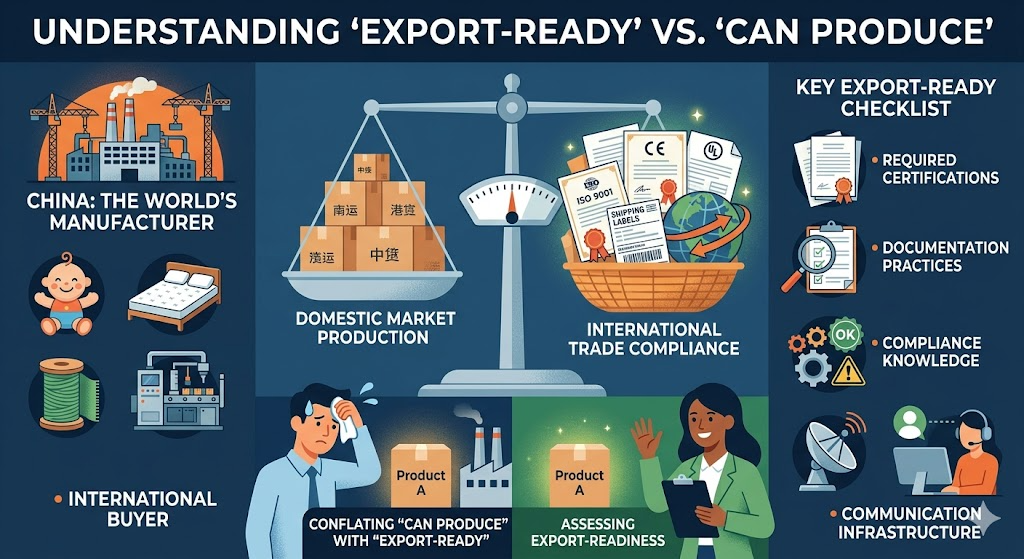
But not every Chinese manufacturer is equipped to serve an international buyer. And for global sourcing teams and first-time importers alike, one of the most consequential mistakes is conflating "can produce" with "export-ready." These are not the same thing. A factory that produces excellent goods for the domestic market may lack the certifications, the documentation practices, the compliance knowledge, and the communication infrastructure that international trade demands.
Understanding what export-readiness actually means and how to assess it is one of the most valuable skills any global buyer can develop.
What Export-Readiness Really Means
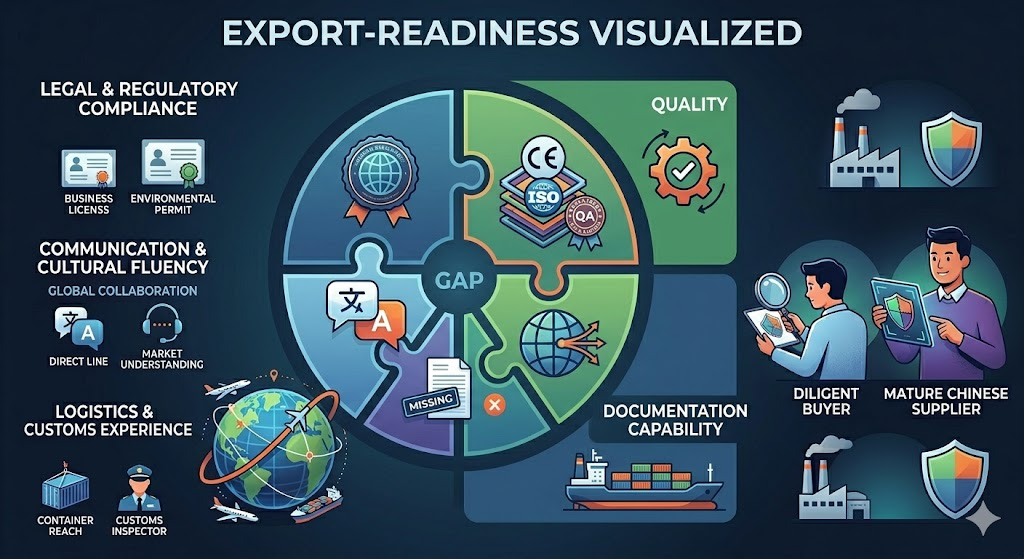
Export-readiness is not a single certification or a badge on a sourcing platform. It is a combination of capabilities that together determine whether a supplier can reliably deliver goods to an international buyer's market in a compliant, consistent, and commercially viable way.
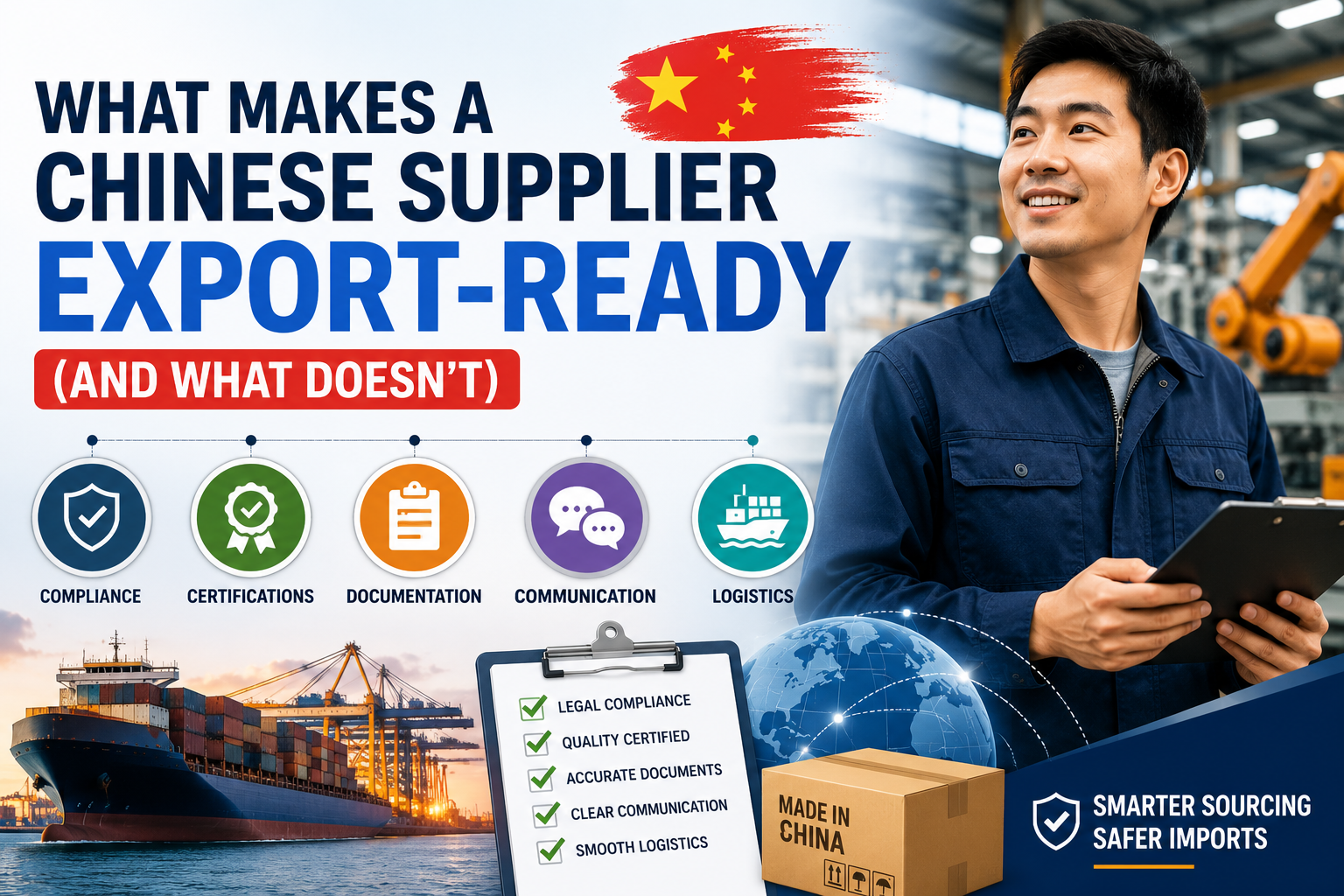
It covers five interconnected dimensions: legal and regulatory compliance, quality systems and certification, documentation capability, communication and cultural fluency, and logistics and customs experience. A supplier who excels in one area but falls short in another is not fully export-ready and the gap will show up at the worst possible moment, usually when goods are at the port or already in your customer's hands.
The good news is that China's export manufacturing ecosystem has matured significantly. A substantial proportion of Chinese suppliers that actively court international business have invested seriously in these capabilities. The challenge for buyers is identifying them accurately separating the suppliers who have done the work from those who present the appearance of export-readiness without the substance.
Legal Registration and Export Licensing
The first indicator of export-readiness is also the most basic: legal registration and the correct export authorisation.
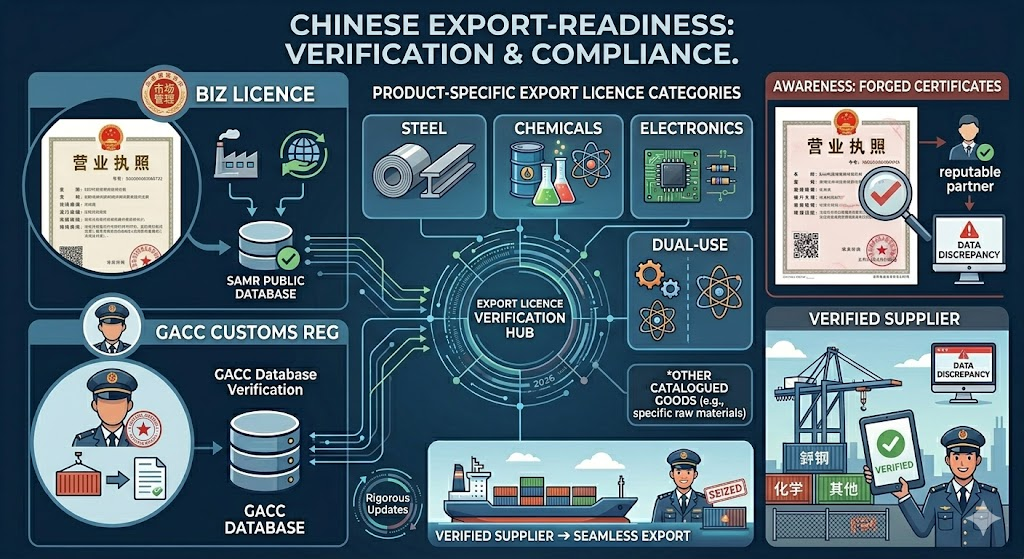
To export goods from China, a supplier must hold a valid business licence issued by China's State Administration for Market Regulation (SAMR) that includes trading or manufacturing within its registered scope. Beyond this, exporters handling goods across most product categories must be registered with the General Administration of Customs of China (GACC) a requirement that became significantly more rigorous following updates to China's export control framework.
China's 2026 Export License Management Catalogue, issued under MOFCOM GACC Announcement 2025 No. 89, designates 43 categories of goods requiring export licensing, with these requirements taking effect on January 1, 2026. For buyers sourcing in affected categories which include steel products, certain chemicals, electronics components, and dual-use goods verifying that a supplier holds the correct export licence for your specific product is non-negotiable.
Many Chinese factories and suppliers provide buyers with forged certificates, which is why importers must pay close attention to certification details to avoid having goods seized at ports. Verification of business registration is publicly available through Chinese government databases, and any reputable sourcing partner can pull this information on your behalf before a relationship is formalised.
Quality Certifications: What They Mean and Which Ones Matter
Quality certifications are the most visible signal of export-readiness and also the most frequently misunderstood.
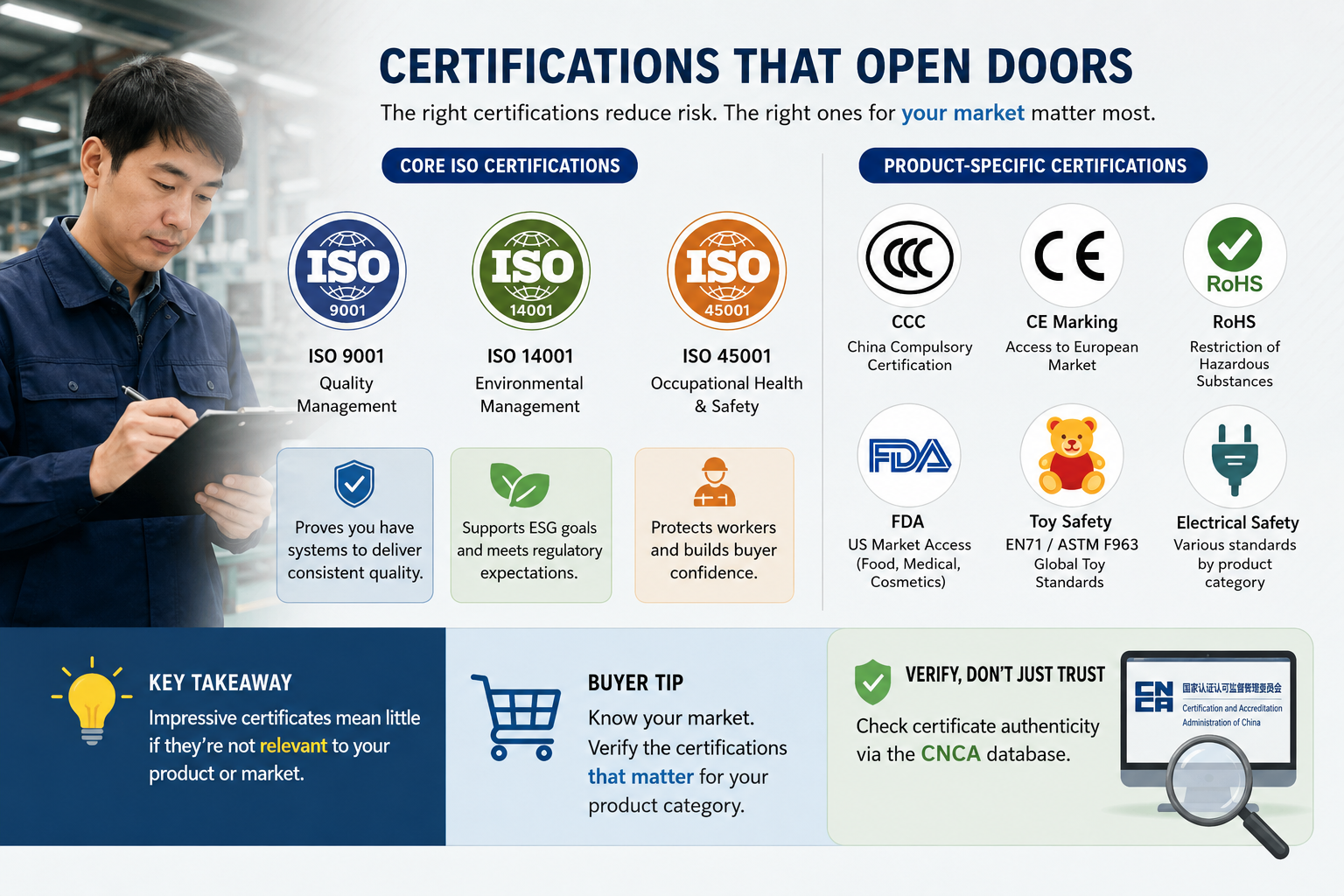
European, North American, and international buyers across retail, automotive, electronics, pharmaceutical, and consumer goods supply chains routinely require ISO certification as a baseline condition for supplier qualification, making ISO 9001, ISO 14001, and ISO 45001 practically mandatory for Chinese manufacturers seeking to access or retain major export relationships.
ISO 9001 is the quality management standard most buyers encounter first. It confirms that a supplier has a documented quality management system defined processes, consistent procedures, and a framework for identifying and correcting quality failures. It does not guarantee the quality of the product itself, but it does confirm that the supplier has the systems to manage quality consistently. For a first-time buyer, an ISO 9001-certified supplier is meaningfully lower risk than one without it.
ISO 14001 covers environmental management and is increasingly required by buyers with ESG commitments or who are selling into regulated markets like the EU, where supply chain environmental disclosures are becoming mandatory. ISO 45001 covers occupational health and safety relevant for buyers whose customers or investors scrutinise labour standards.
Beyond ISO, product-specific certifications matter enormously depending on your category. China Compulsory Certification (CCC) applies to a wide range of products including electrical equipment and toys, with the two most important elements being product testing and factory audits by Chinese certification authorities. CE marking is required for products entering the European market across dozens of categories. RoHS certification governs restrictions on hazardous substances in electronics. FDA registration is required for food, cosmetics, and medical devices entering the US market.
The critical point for buyers is this: the certifications that matter are the ones required in your specific target market for your specific product category. A supplier may hold impressive-looking certifications that are irrelevant to your needs while lacking the specific compliance documentation your market requires. Always verify certification relevance, not just certification existence.
One further caution: the requirements for Chinese suppliers are often related to quality management, environmental protection, safety, and appropriate production facilities and certificates should always be verified for authenticity, not simply accepted at face value. Certification bodies whose names appear on Chinese export certificates can be verified through the CNCA (Certification and Accreditation Administration of China) database.
Documentation Capability: The Hidden Differentiator
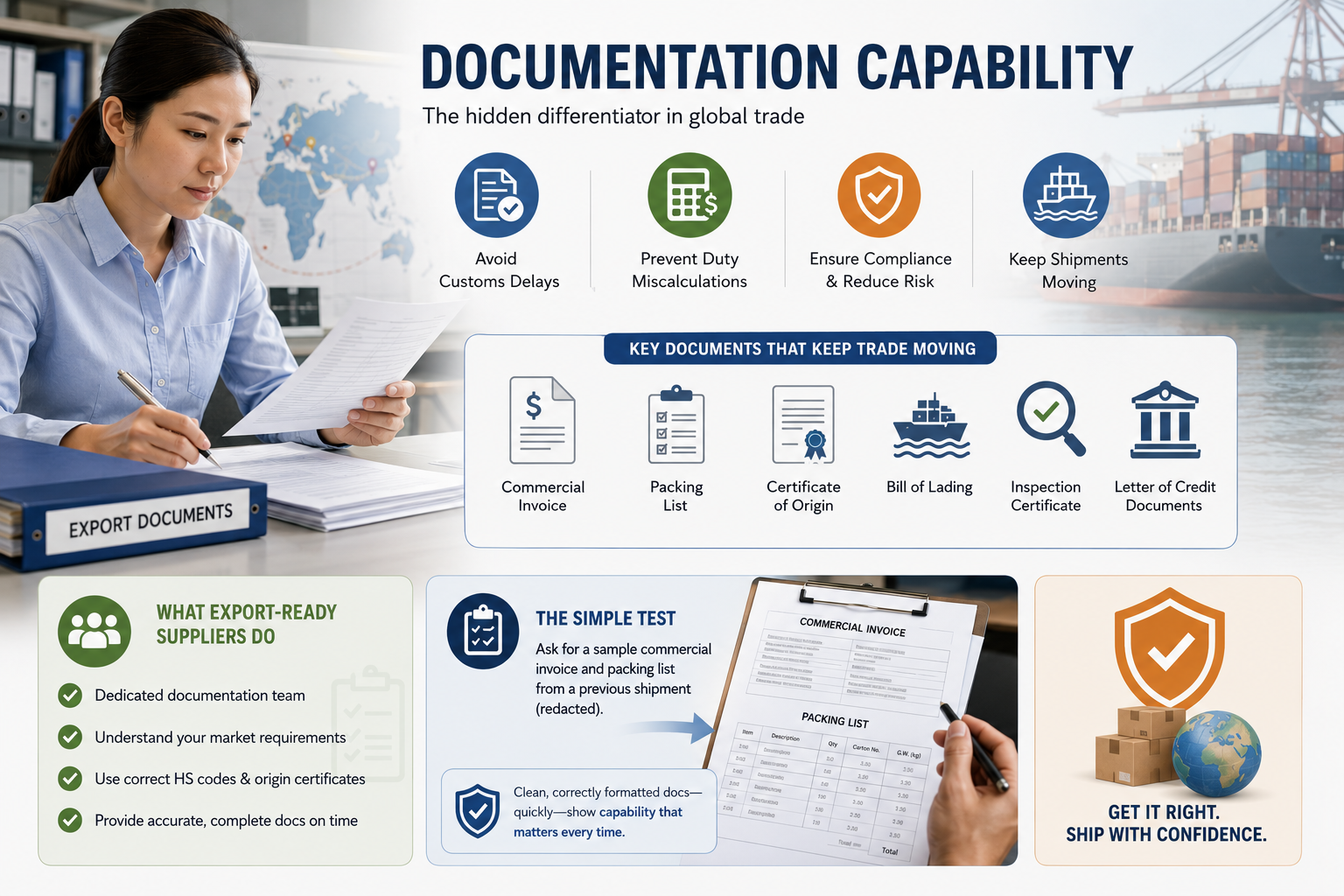
Documentation is one of the least glamorous aspects of export-readiness and one of the most consequential. International trade runs on paperwork commercial invoices, packing lists, certificates of origin, bills of lading, inspection certificates, letters of credit documentation and a supplier who cannot produce accurate, complete documentation on time will create customs delays, duty miscalculations, and compliance failures that cost buyers far more than any unit price saving is worth.
A genuinely export-ready Chinese supplier will have a dedicated export documentation team or a competent trading department that understands the document requirements of your target market. They will know the difference between a General Certificate of Origin and a Form A preferential origin certificate. They will understand how to correctly declare the HS code for your product a classification error that can result in incorrect duty rates being applied, triggering customs queries that delay your shipment and create compliance risk.
The test of documentation capability is not a question it's a request. Ask a potential supplier to provide you with a sample commercial invoice and packing list from a previous export shipment, with commercially sensitive details redacted. A supplier who can produce clean, correctly formatted documentation quickly is demonstrating a capability that matters every time a shipment moves.
Communication Infrastructure and Cultural Fluency
Export-readiness is not purely a compliance and certification question. It is also a communication question and for many buyers, it's where the practical relationship either works or doesn't.
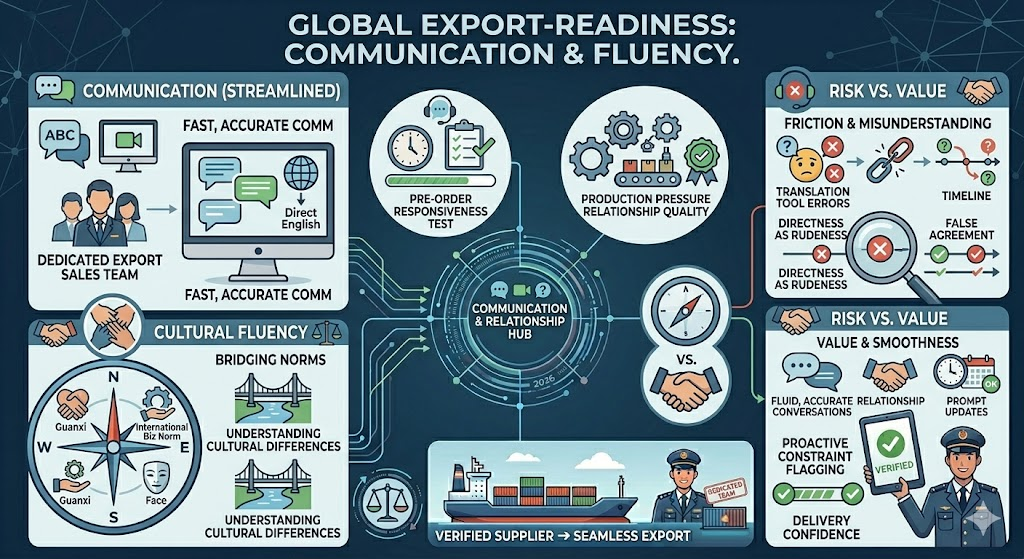
A supplier who cannot communicate clearly in English or who relies entirely on translation tools for all interaction creates friction at every stage of the sourcing process. Specification discussions, sample feedback, production updates, quality issue resolution: all of these require responsive, accurate communication. A supplier with a dedicated export sales team that communicates fluently, responds promptly, and understands international business norms is providing a capability that has genuine commercial value.
Cultural fluency matters too. Chinese business culture has its own norms around relationship-building, negotiation, and face the concept of preserving dignity and reputation in professional interactions. A supplier who has worked extensively with international buyers understands how to bridge these cultural differences. One who has not may interpret directness as rudeness, or agree to timelines out of politeness rather than genuine confidence in their delivery capability.
Experienced buyers often use the early communication phase before any order is placed as a deliberate test of a supplier's responsiveness and clarity. How quickly do they respond? How specific are their answers? Do they proactively flag constraints or simply confirm whatever is asked? These behaviours in the pre-order phase are reliable predictors of the relationship's quality under production pressure.
Logistics and Customs Experience
The final dimension of export-readiness is logistics capability and specifically, a supplier's experience navigating the customs and freight infrastructure that gets goods from their factory to your door.
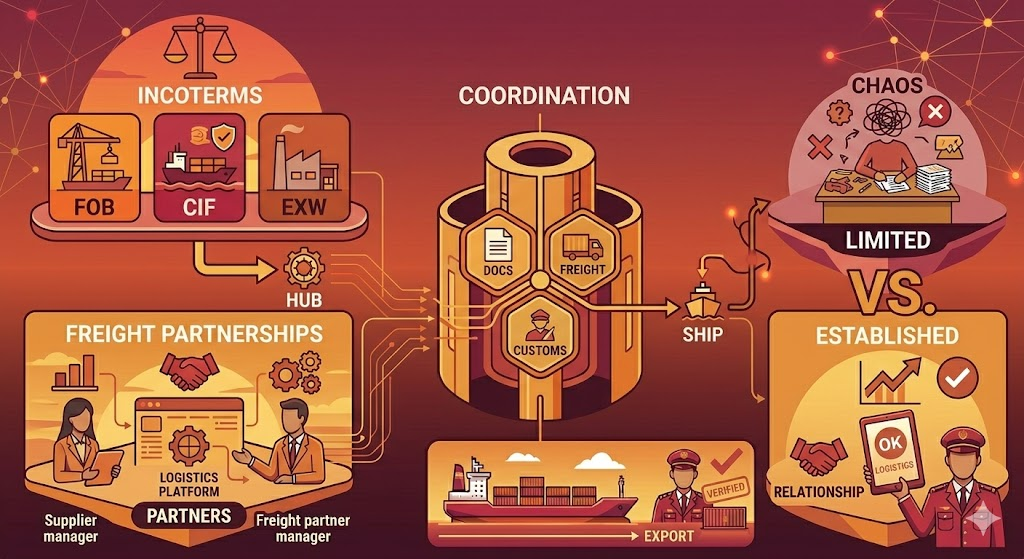
A truly export-ready supplier understands Incoterms the internationally standardised trade terms that define who bears risk and cost at each stage of the shipping journey. They can produce goods on both FOB (Free on Board) and EXW (Ex-Works) terms depending on your preference, and they understand the implications of each. A supplier who doesn't know what Incoterms are, or who can only work on one set of terms without explanation, is signalling limited export experience.
Established relationships with freight forwarders and customs brokers are another positive indicator. A supplier who regularly exports through reliable logistics partners has a smoother, faster, and more predictable export process than one who is arranging freight from scratch with each order. For buyers, this translates directly into more reliable lead times and fewer shipment surprises.
What Doesn't Make a Supplier Export-Ready
It's worth being equally clear about what export-readiness is not.
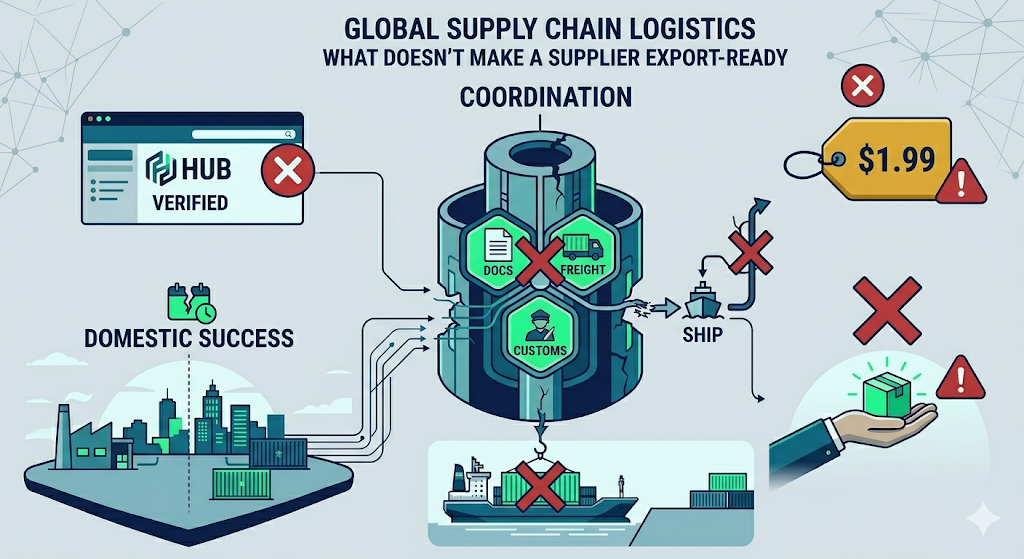
A presence on Alibaba or a similar B2B platform is not evidence of export-readiness. Platform listings confirm that a supplier has paid for a profile and responded to platform verification steps neither of which requires the capabilities described above.
A long trading history in the domestic market does not transfer directly to export capability. Many excellent Chinese manufacturers serve the domestic market exclusively and have never navigated international compliance requirements, foreign language communication, or overseas customs documentation.
Competitive pricing is not a proxy for export-readiness. Some of the least export-ready suppliers offer the most aggressive prices often because they haven't invested in the certifications, quality systems, and documentation infrastructure that export-ready suppliers carry as overhead.
And a good sample, while necessary, is not sufficient. A sample proves that a supplier can produce your product once, under controlled conditions, when they know they are being evaluated. It does not prove that they can maintain that standard at production scale, across repeated orders, under real deadline pressure.
How SourceWithAI Identifies Truly Export-Ready Suppliers
Assessing export-readiness accurately requires local knowledge, language capability, and direct supplier relationships that most international buyers simply don't have access to on their own. That's the gap SourceWithAI is built to close.
Our supplier discovery and matching service connects international buyers with pre-verified Chinese suppliers who have been assessed across the full spectrum of export-readiness legal registration, relevant certifications, documentation capability, communication quality, and logistics experience. We don't surface the loudest names on public platforms. We surface the suppliers who have demonstrated the capabilities your market and your product require.
Our sourcing consultation service supports buyers who want to understand what export-readiness means for their specific product category and target market helping you build the right supplier qualification criteria, verify credentials accurately, and avoid the gaps that turn a promising supplier relationship into a costly one.
In China's manufacturing ecosystem, the difference between a supplier who can produce and a supplier who is genuinely export-ready is significant. Knowing how to tell them apart is one of the most valuable advantages a sourcing team can have.
SourceWithAI.com helps global buyers source smarter from China with verified suppliers, expert consultation, and on-the-ground expertise that buyers can trust.
Written by
Eva Liu
June 11, 2026 · 8 min read