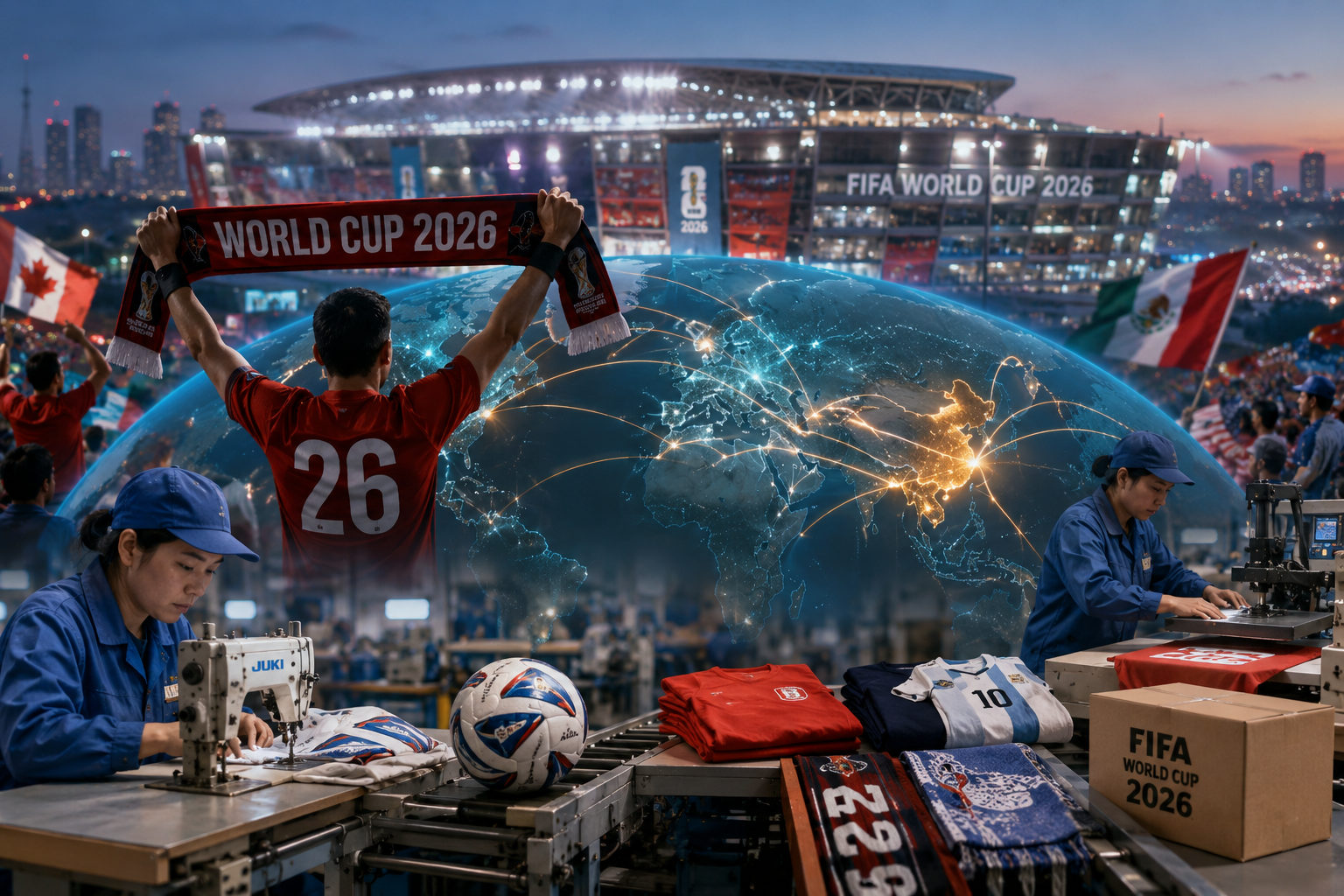
The 2026 FIFA World Cup is the biggest sporting event on earth. Forty-eight teams. One hundred and four matches. Sixteen cities across the United States, Canada, and Mexico. Billions of fans watching from stadiums, fan zones, living rooms, and hotel lobbies around the world.
And behind almost every physical product in that picture the scarf around a fan's neck, the jersey on their back, the flag in their hand, the ball on the pitch is a city in China you've probably never heard of.
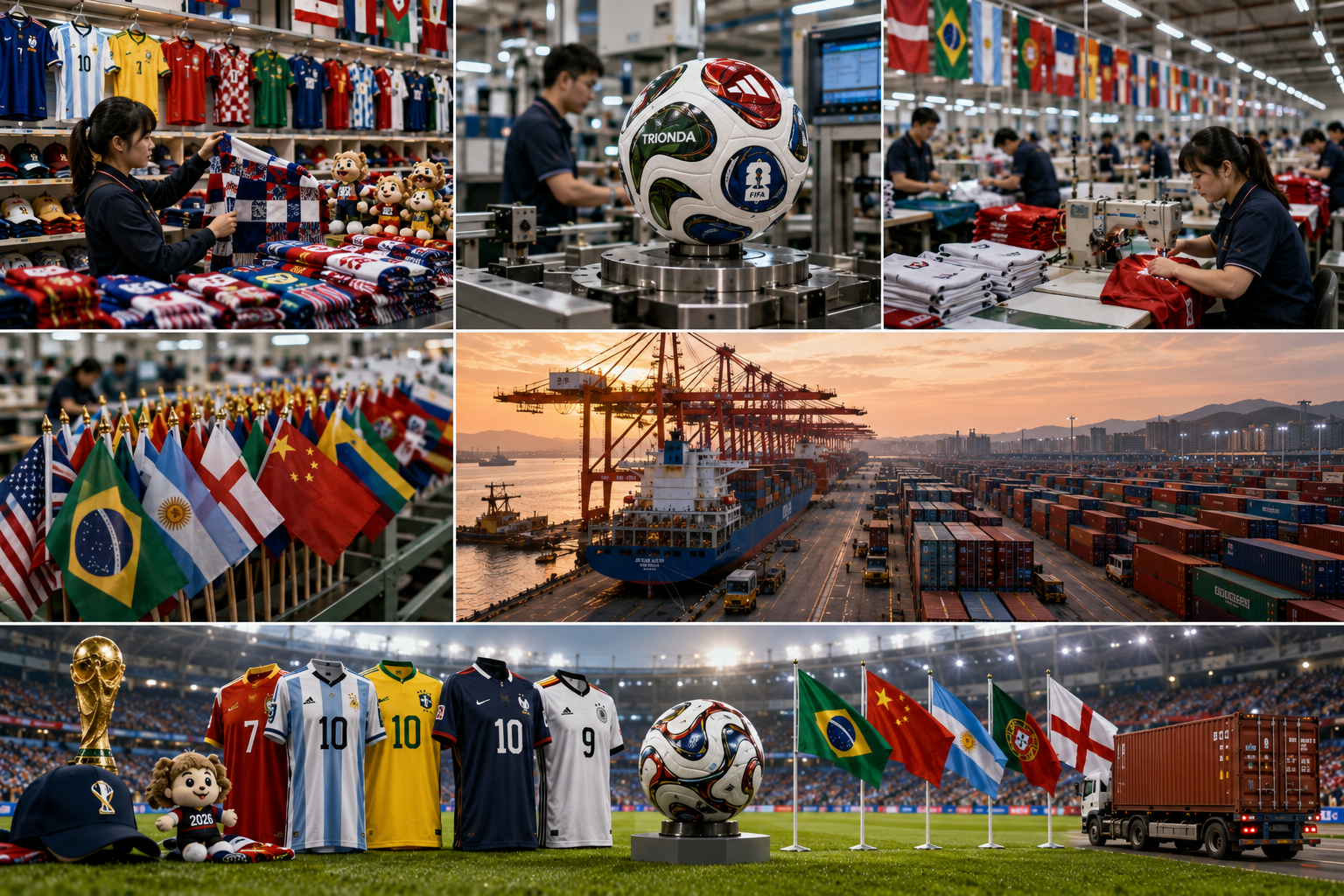
China's role in the World Cup is not a footnote. It is the supply chain. While the world watches the football, a network of Chinese manufacturing cities is quietly running the commercial engine that makes the whole spectacle possible. Understanding which cities make what and how they do it is one of the most revealing windows into how global sourcing actually works.
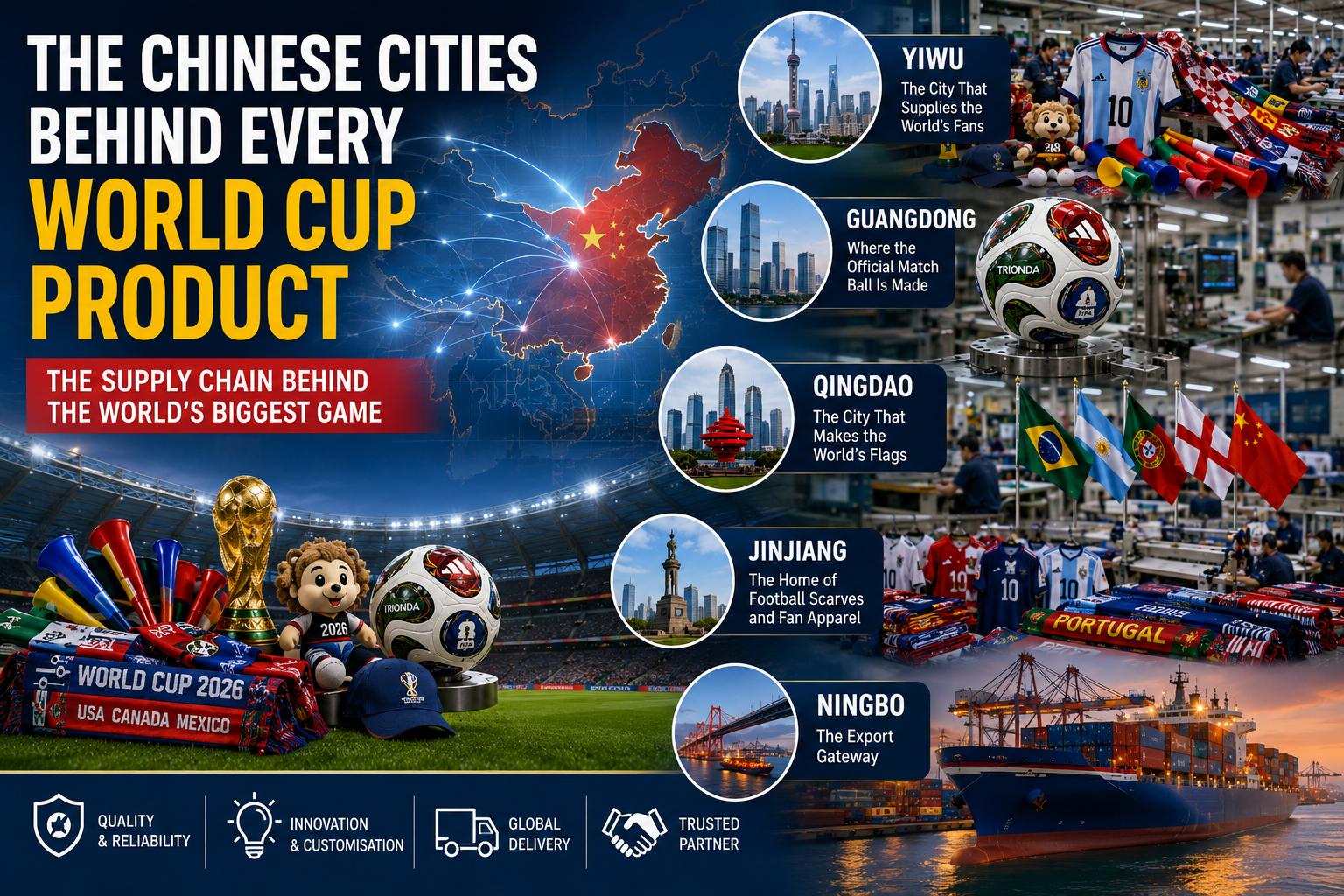
Yiwu: The City That Supplies the World's Fans
If there is one city that defines the World Cup's supply chain, it is Yiwu.
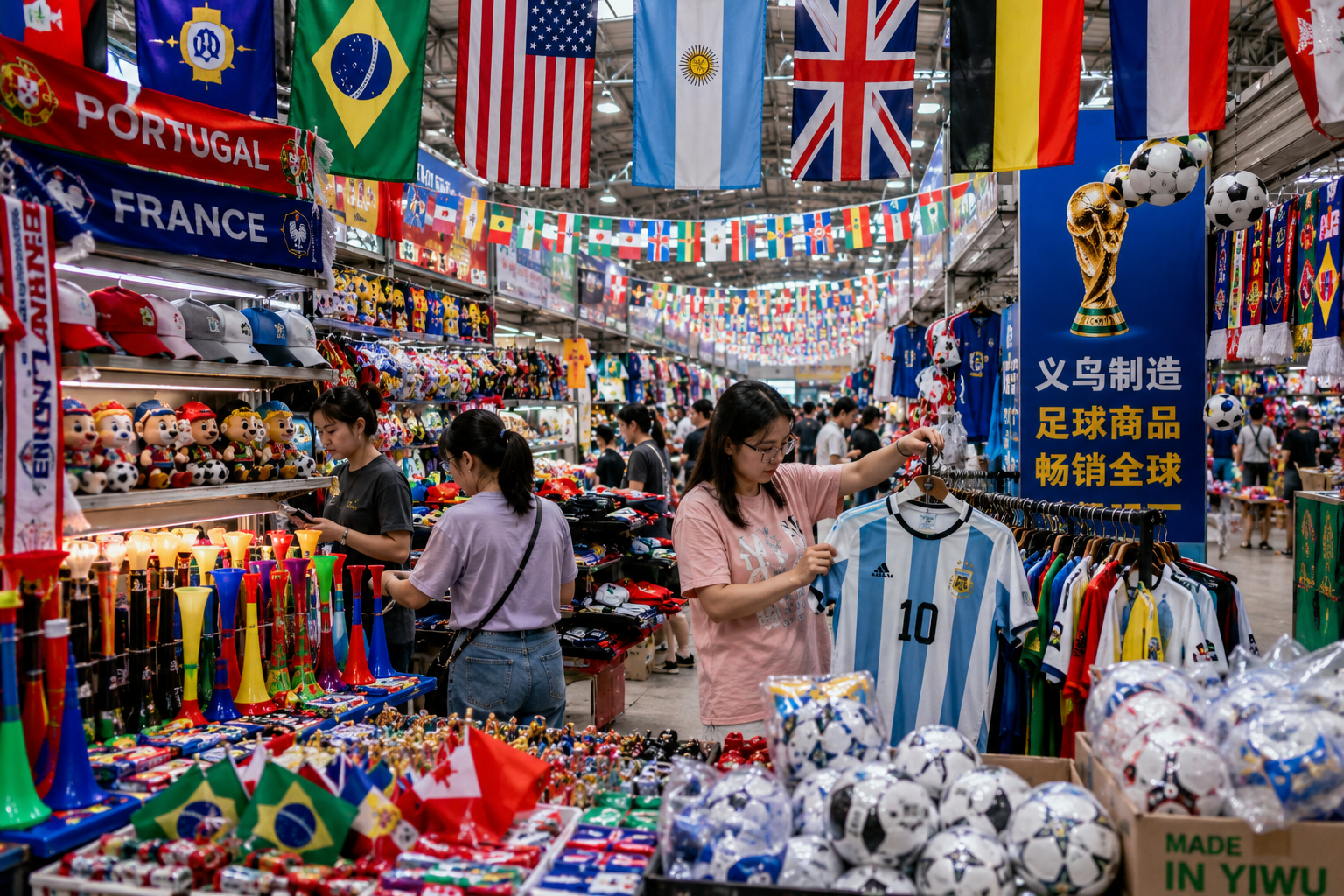
Known internationally as "the world's supermarket," Yiwu is a small city in Zhejiang Province that produces an estimated 2.1 million kinds of goods, exported to 233 countries and regions. It is home to the world's largest wholesale market for small commodities a trading complex so vast that it takes days to walk through properly. And for World Cup 2026, it is operating at a scale that is genuinely difficult to comprehend.
Nearly 70% of World Cup-related merchandise is produced in Yiwu, according to data from the Yiwu Sports Goods Association. From January to April 2026 alone, Yiwu exported 3.77 billion yuan approximately $554 million worth of sports goods and equipment, up 7.9% year-on-year. Orders have been rolling in from Mexico, Europe, and the United States, transforming this hub of small-commodity manufacturing into what one local trader described as "a scoring zone for global demand."
What Yiwu makes for the World Cup covers almost every fan-facing product category. Jerseys in every national team design. Scarves knitted and printed in club and country colors. Flags for all 48 participating nations. Cheering horns, vuvuzelas, and noise makers. Mascot dolls. Keyrings and lanyards. Hats, caps, and beanies. And in 2026, an expanding range of premium and customized products football-themed figurines, pet jerseys, cultural creative merchandise that reflect a broader shift in what global buyers are asking for.
One of Yiwu's most established fan apparel exporters, Yiwu Danas Import and Export Co., demonstrates the city's scale of ambition. During the 2022 Qatar World Cup, their Danas-branded fan jerseys achieved global sales of more than 2 million units. For 2026, they began preparing designs and applying for international design patents more than a year before the tournament securing over 40 overseas patents for World Cup supporter jerseys before a single match had been played. "The final teams haven't been decided, but we have to prepare in advance," said the company's chairman. Jerseys for host countries and football powerhouses including Argentina, France, Germany, and Brazil were ready and sent to clients for review months ahead of the opening game.
This is Yiwu's defining characteristic: the ability to rapidly turn around themed merchandise for global events, at scale, with a speed and commercial intelligence that no other city on earth currently matches.
Guangdong: Where the Official Match Ball Is Made
While Yiwu supplies the fans, Guangdong supplies the game itself.
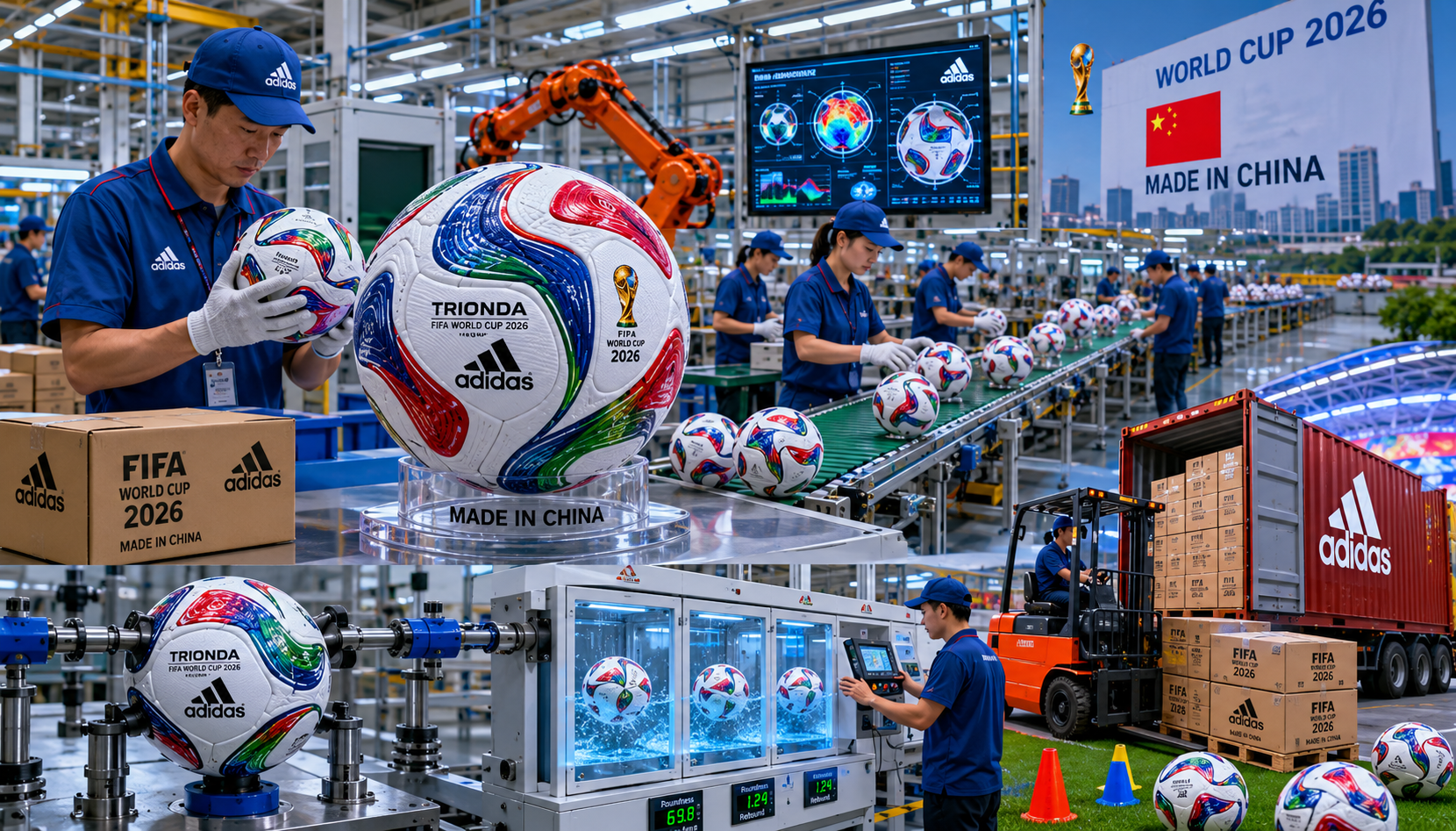
The official match ball for World Cup 2026 is the Adidas Trionda a ball featuring a new four-panel splicing structure that places higher demands on material ratio, thermal bonding technology, weight precision, and roundness control than any previous World Cup ball. It is produced and tested in a contract factory in Guangdong, China. Every ball that leaves the factory is printed with three words: Made in China.
The manufacturing of an official World Cup match ball is not comparable to ordinary ball production. It must meet FIFA's strict competitive performance standards water absorption, resilience, flight stability alongside detailed specifications for batch consistency, durability, and long-term usage under tournament conditions. In the Guangdong factory, each ball passes through multiple production stages: raw material cutting, hot-melt moulding, surface texture pressing, weight adjustment, and flight testing, with precision instrument inspection at every step.
Guangdong's role in the World Cup supply chain extends beyond the match ball. The province is China's most industrially diverse manufacturing base the home of Shenzhen's electronics manufacturing, Guangzhou's apparel production, Dongguan's footwear and accessories, and Foshan's furniture and home goods. For World Cup 2026, Guangdong factories are producing everything from official licensed merchandise to the broader category of sports equipment and fan electronics that surrounds a tournament of this scale.
Qingdao: The City That Makes the World's Flags
Every flag waved in every stadium at World Cup 2026 has a story that begins in Qingdao.
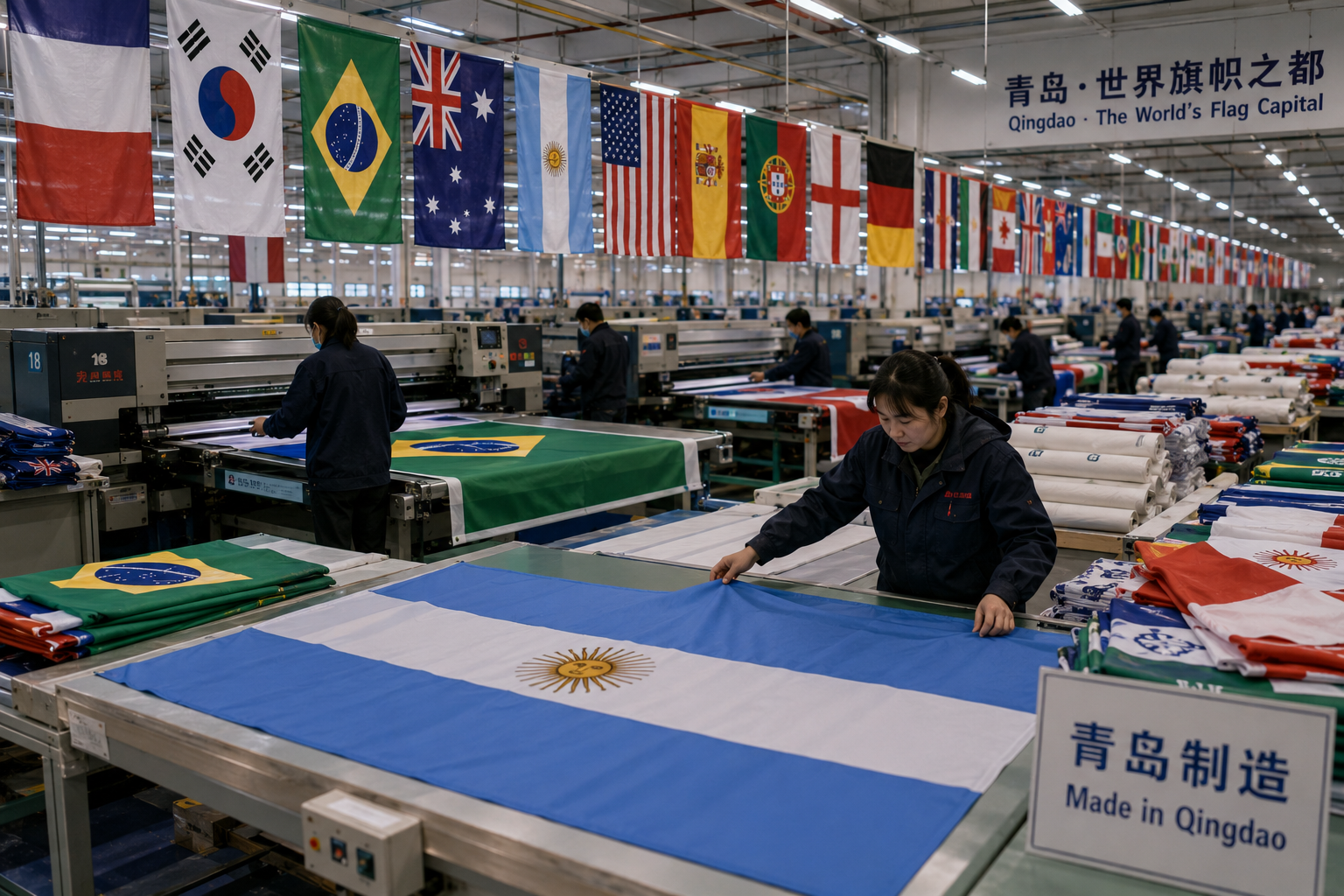
This coastal city in Shandong Province has built a global reputation as the world's flag manufacturing capital. Qingdao's textile firms have made around 10 million flags for the 2026 World Cup so far, with total output projected to exceed 30 million throughout the tournament. That is an extraordinary number but for Qingdao's flag manufacturers, it is simply what they do.
The scale of World Cup 2026 has pushed Qingdao's production operations to their limits. On April 1, when the last qualifying match was completed and the list of all 48 participating nations was confirmed, orders flooded in immediately. "We were ready," said the chairman of Qingdao Wonderful Flag Industry Co. a statement that reflects not just preparation but decades of experience turning global event schedules into production timelines.
Qingdao's flag production operation encompasses everything from hand flags and car flags to stadium banners, wall hangings, and branded promotional textiles. The city's textile infrastructure supports not just quantity but quality consistency at scale a capability that becomes critical when a single brand or event organiser needs hundreds of thousands of identical items delivered within a compressed window.
Jinjiang: The Home of Football Scarves and Fan Apparel
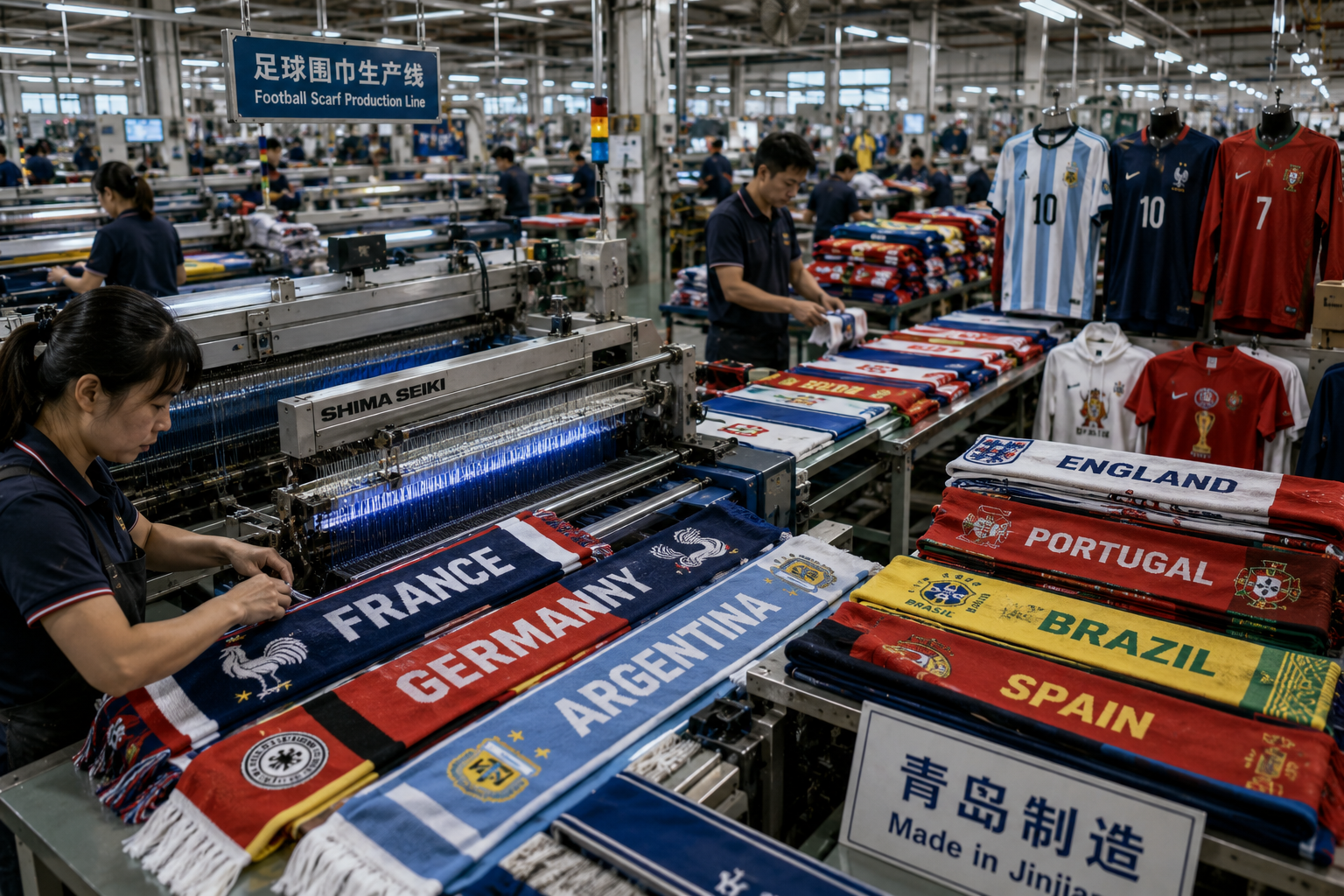
While Yiwu handles the broadest range of fan merchandise, Jinjiang in Fujian Province has carved out a specific specialisation that makes it one of the most important cities in the World Cup sourcing ecosystem: football scarves and fan apparel.
Jinjiang is where most of the world's football scarves are made. Knitted acrylic bar scarves the classic item that fans wave in the stands and wrap around stadium railings leave Jinjiang factories by the millions for every major football tournament. Alongside scarves, Jinjiang produces a wide range of fan apparel: replica jerseys, supporter t-shirts, hooded tops, and the kind of branded fan kit that fills official merchandise stores and informal market stalls in equal measure.
What makes Jinjiang notable for sourcing teams is its flexibility. Factories in the city have developed production systems capable of handling multiple designs at relatively low minimum order quantities a combination that is notoriously difficult to find in manufacturing, and one that has made Jinjiang the preferred source for brands building multi-team or multi-country fan kit ranges. For a brand producing customised scarves across ten national team designs at modest volumes per SKU, Jinjiang is where the answer most often lives.
Ningbo: The Export Gateway
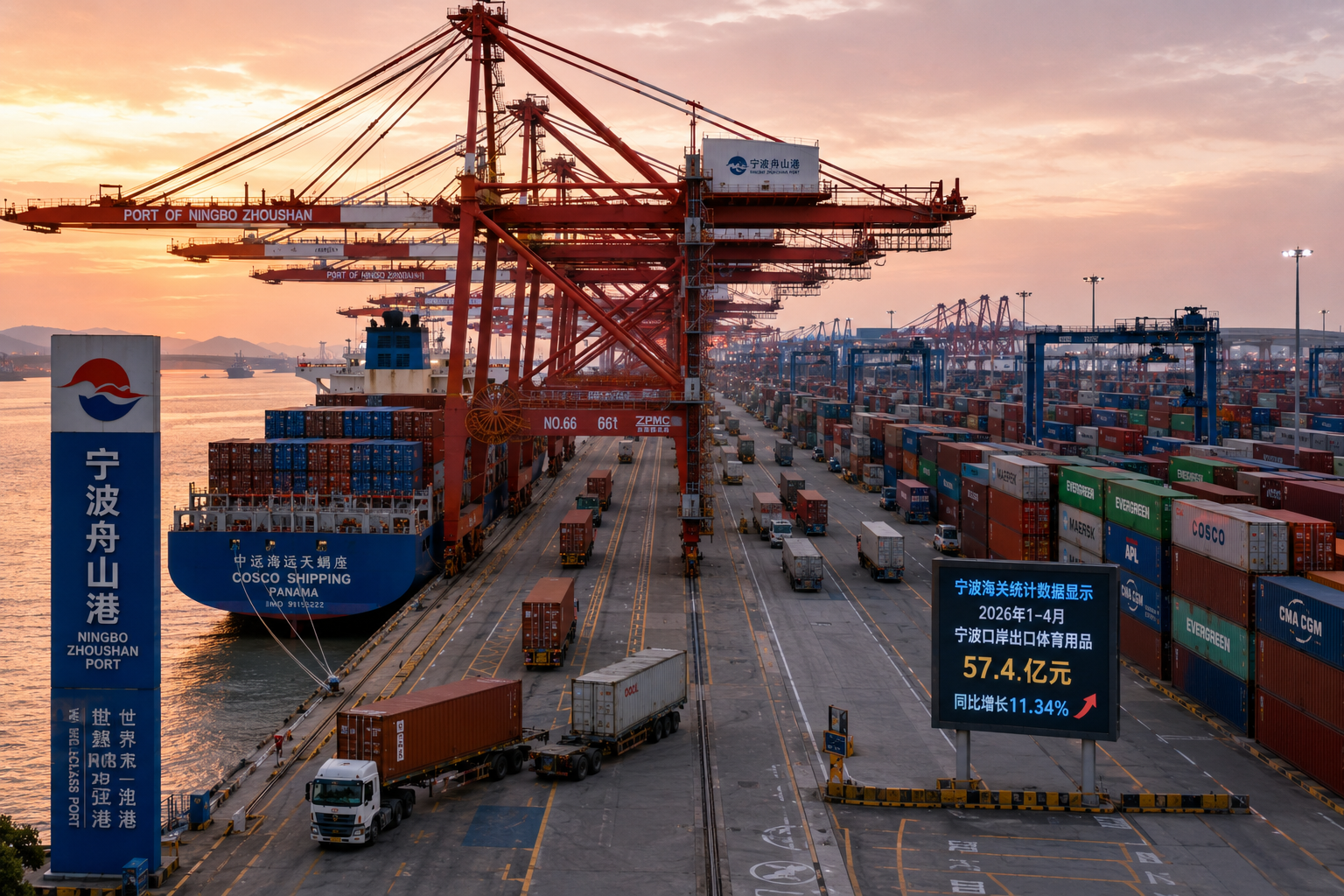
No account of China's World Cup supply chain is complete without Ningbo not primarily as a manufacturing city, but as the logistics engine that moves everything.
Ningbo Customs data shows that exports of sports equipment through the Ningbo port reached 5.74 billion yuan in January to April 2026, up 11.34% compared to the same period the previous year. Ningbo's port is one of the world's busiest container ports, and it serves as a critical export gateway for goods produced across Zhejiang, Jiangsu, and Anhui provinces a manufacturing catchment area that includes Yiwu, Hangzhou, and dozens of smaller industrial cities feeding into the World Cup supply chain.
For buyers shipping World Cup merchandise to the United States the primary host nation for 2026 Ningbo to Los Angeles or Long Beach is one of the busiest and most operationally established trade lanes in the world. Understanding Ningbo's role in the logistics chain matters because port capacity, vessel schedules, and peak season freight rates at Ningbo directly affect the landed cost and delivery timeline of goods sourced from the broader Zhejiang manufacturing ecosystem.
The Bigger Picture: China Is Moving Up the Value Chain
What makes the 2026 World Cup supply chain story different from previous tournaments is not just the scale it is the direction of travel.
China's connection to the World Cup began with volume. Flags, scarves, and small fan merchandise produced at the lowest possible price point, shipped in enormous quantities, competitive on cost above all else. That model still exists, and it still defines the bulk of fan merchandise production. But alongside it, something more interesting is happening.
Chinese manufacturers are now not only pursuing volume, but value-added products. Design patents, premium materials, personalisation capability, and licensed merchandise production are becoming increasingly significant parts of the offering. Customised products merchandise featuring different national elements, cultural design details, and personalised specifications are becoming a new trend, reflecting a broader shift toward personalisation in global sports merchandising.
The city of Yiwu alone has registered more than 40 overseas design patents for 2026 World Cup supporter jerseys. The Guangdong factory producing the official match ball is operating to technical specifications that require precision instrument testing at every production stage. These are not the outputs of a manufacturing base competing solely on price they are the outputs of one that is systematically building quality, design, and technical capability into its core offering.
For sourcing professionals and brand buyers, this evolution matters. The Chinese manufacturing cities supplying World Cup 2026 are not just cheaper alternatives to Western production they are the most capable, most experienced, and most agile suppliers of event merchandise in the world. The brands that understand this and that know which city to go to for which product are the ones arriving with the right goods, at the right time, at the right price point.
How SourceWithAI Connects You to the Right City for Your Product
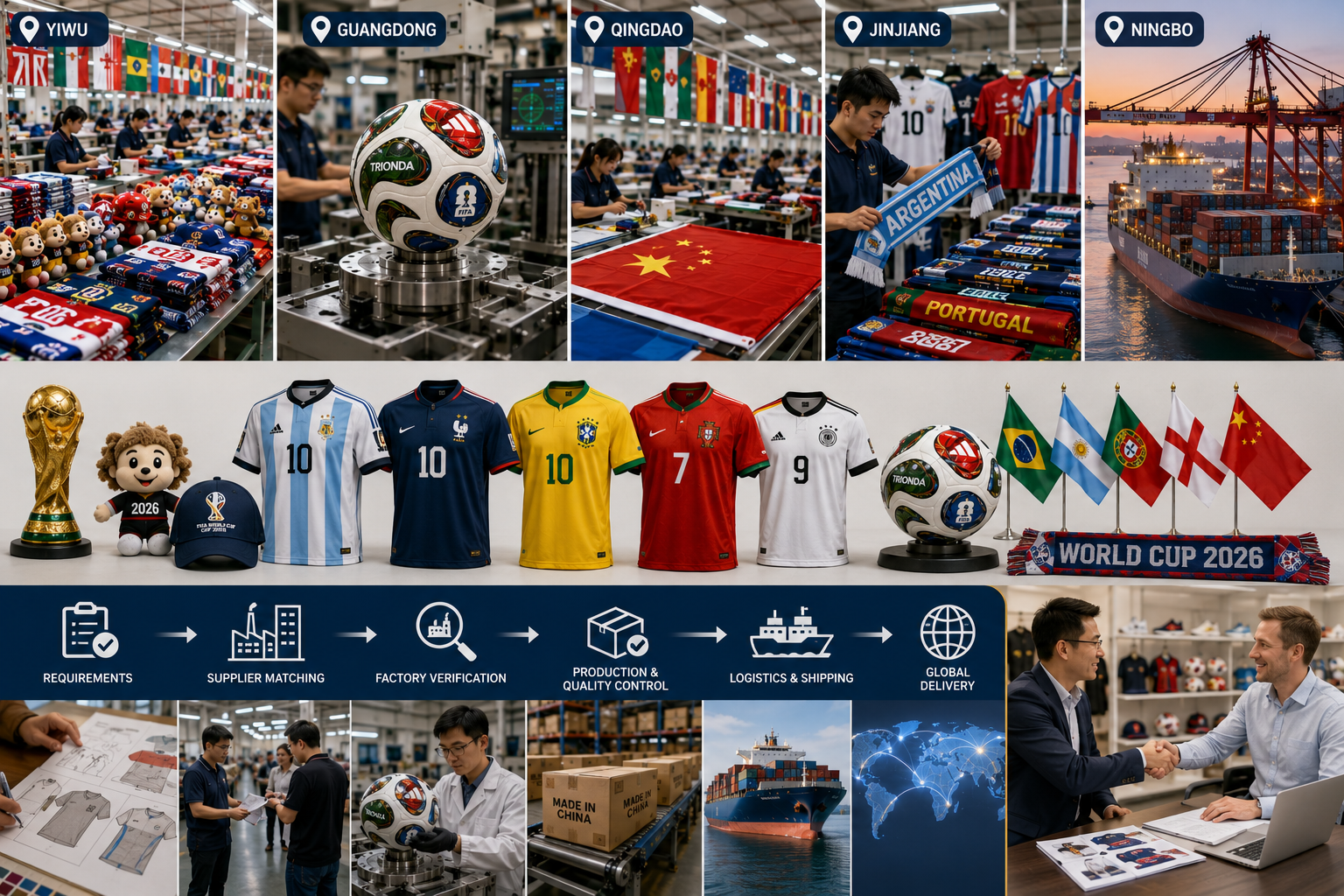
Knowing that Yiwu makes scarves and Qingdao makes flags is useful context. Knowing which specific factory in Yiwu can handle your MOQ, your custom design requirements, your quality standard, and your delivery timeline that is the intelligence that turns sourcing knowledge into sourcing results.
At SourceWithAI, we work across China's manufacturing ecosystem including the cities covered in this article and the specialist production clusters within them. Our supplier discovery and matching service connects international buyers with pre-verified manufacturers in the right location for their specific product category, whether that is fan apparel in Jinjiang, small merchandise in Yiwu, flags in Qingdao, or technical sporting goods in Guangdong.
Our sourcing consultation service helps buyers navigate the World Cup sourcing window understanding lead times, production capacity constraints during peak tournament season, and the logistics realities of getting goods from Chinese factories to host nation markets within the commercial window that makes them relevant.
The World Cup supply chain runs through China. Knowing how to access it and who to work with inside it is the advantage that separates brands that capitalise on the moment from those that watch it pass.
SourceWithAI.com helps global buyers source smarter from China with verified suppliers, expert consultation, and on-the-ground expertise that buyers can trust.
Written by
Eva Liu
June 18, 2026 · 9 min read