
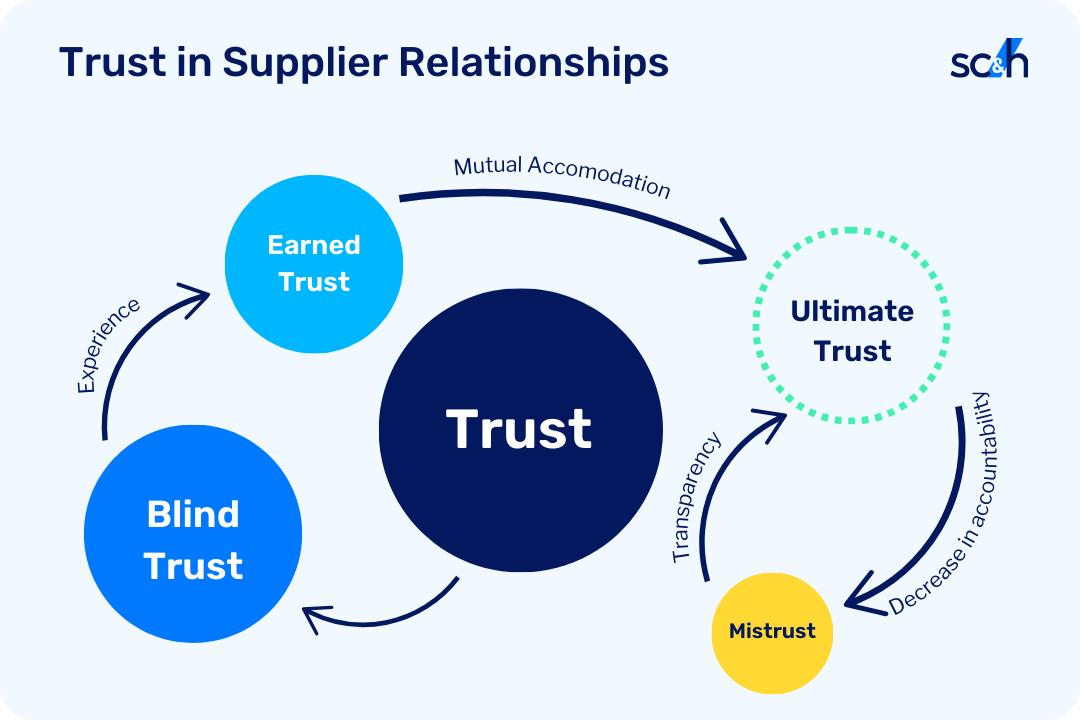
The most successful sourcing relationships aren't built on price alone. They're built on trust the confidence that both sides will be treated fairly, communicate openly, and honour commitments when things get hard.
AI is reshaping how those relationships begin, develop, and endure. And the sourcing teams that will win over the next decade aren't just the ones adopting AI the fastest they're the ones using it in a way that deepens trust rather than quietly eroding it.
Ethical AI sourcing isn't a constraint on progress. It's the foundation of procurement that is not only faster and smarter, but genuinely better for your organisation, your suppliers, and the supply chains you depend on.
Here's what sourcing with integrity actually looks like and why it's becoming the defining differentiator for world-class procurement teams.

Trust Is the Most Undervalued Asset in Procurement
Ask any experienced supply chain manager what separates a good supplier relationship from a great one, and the answer is rarely price or speed. It's trust. The belief that your supplier will flag a problem before it becomes your problem. That they'll prioritise your order when capacity is tight. That the relationship is worth protecting on both sides.
That kind of trust takes years to build and moments to destroy. And as AI becomes more embedded in sourcing decisions from supplier discovery and evaluation to risk scoring and contract analysis the way those systems treat suppliers matters enormously.
When suppliers feel that they are being assessed fairly, communicated with transparently, and given the opportunity to be heard, they invest more in the relationship. When they feel screened out by opaque algorithms or dropped without explanation, they disengage and they remember.
Ethical AI is the mechanism that protects and strengthens supplier trust at scale. It ensures that the speed and efficiency AI brings doesn't come at the cost of the relationships that make your supply chain resilient.

Transparency: The Foundation Suppliers Are Asking For
One of the most significant shifts happening in procurement right now is the growing expectation of transparency from suppliers, from regulators, and from internal stakeholders alike.
Transparency in AI-powered sourcing means that every step of the supply chain from how suppliers are identified to how they are evaluated and selected is traceable and auditable. It means suppliers can understand why a decision was made, not just what the decision was.
This matters in practice. When a supplier loses a bid or is flagged for a risk review, they deserve more than a system-generated notification. They deserve a clear, human-understandable explanation of the criteria that shaped that outcome. Procurement teams that provide this build reputations as fair, professional partners the kind that suppliers actively want to work with.
Transparency is vital to building trust in AI-driven procurement processes. It means procurement teams and their stakeholders should be able to understand how an AI tool is arriving at its outputs or recommendations.
The regulatory environment is accelerating this shift. The EU AI Act now mandates that companies document how their AI systems work, how data is processed, and how risks are mitigated specifically in sectors including procurement, contract management, and logistics. In the US, the GSA's proposed clauses require federal contractors using AI in bids to disclose data sources, allow for algorithmic audits, and guarantee data portability. California's March 2026 Executive Order directs state procurement agencies to implement new trust and safety obligations on AI companies seeking government contracts.
The direction of travel is clear. Transparency isn't coming it's here. The organisations building it into their sourcing processes now will have a head start that compounds over time.
Fairness: Opening the Door to Better Suppliers
Here's one of the most exciting and underappreciated opportunities that ethical AI creates for sourcing teams: the chance to discover suppliers you've been systematically missing.
Traditional procurement has always had a selection bias problem. The suppliers who win tend to be the ones who are already known incumbents, large firms, geographies that feel familiar. New entrants, smaller businesses, and suppliers from underrepresented markets rarely get a fair look, not because they lack capability, but because the sourcing process wasn't designed to find them.
AI, used ethically, changes this. AI algorithms map complex supply chains, revealing hidden tiers and potential risk areas, while also surfacing suppliers that would never appear in a conventional vendor directory. AI-powered traceability systems can track supplier credentials, certifications, and compliance records efficiently and at scale removing the manual gatekeeping that has historically favoured established names.
The key word is ethically. AI trained exclusively on historical sourcing decisions will simply replicate the biases of the past at greater speed. Sourcing teams that actively work to ensure their AI tools are trained on diverse, representative data and that regularly audit outputs for signs of supplier concentration are the ones unlocking the full value of AI discovery.
The payoff is real. A more diverse supplier base isn't just a social good it's a resilience strategy. Over-reliance on a narrow group of familiar suppliers is precisely the kind of structural vulnerability that leaves supply chains exposed when disruptions hit. Ethical AI helps you build breadth before you need it.

Accountability: Turning AI Recommendations into Trusted Decisions
There is a meaningful difference between an AI recommendation and an AI decision. The best sourcing teams understand this distinction and use it to their advantage.
AI should surface intelligence: risk signals, pricing benchmarks, supplier performance trends, market alternatives. Humans should own the judgement: which suppliers to engage, which relationships to invest in, which risks are worth taking. When that division is clear, AI amplifies the quality of human decision-making without displacing the accountability that makes those decisions defensible.
A well-designed AI governance framework for procurement covers five pillars: accountability clear ownership of AI outputs; transparency explainable decision logic; fairness bias monitoring and mitigation; risk management security and compliance; and data governance quality standards and access controls.
In practice, leading procurement teams are formalising this through AI ethics boards or governance committees that include procurement, IT, legal, and risk executives. These groups set the rules of engagement for AI tools which decisions require human sign-off, how supplier challenges are handled, and how AI outputs are communicated externally. According to IBM, 80% of organisations now have part of their risk function dedicated to AI a sign that accountability for AI is becoming a board-level concern, not just an IT one.
For supply chain managers, this is an opportunity to lead. The CPOs and procurement directors who build these governance structures now before they are required will be the ones who earn the trust of suppliers, regulators, and leadership when the scrutiny intensifies.

From Reactive Compliance to Proactive Responsibility
There is a version of ethical AI adoption that is purely defensive: do the minimum required to stay compliant, document the necessary policies, and move on. That approach protects against regulatory risk but it leaves the real value on the table.
The more powerful version is proactive responsibility: using AI to do things that weren't previously possible, in ways that actively make your sourcing better for everyone involved.
AI offers a suite of powerful tools to improve ethical sourcing practices. From enhancing supply chain visibility and risk detection to automating supplier verification and improving traceability, AI is enabling companies to move beyond reactive compliance to proactive responsibility building more ethical and sustainable supply chains that benefit both organisations and their supplier communities.
What does proactive responsibility look like for a supply chain manager in 2026?
It looks like using AI to monitor supplier labour and environmental practices in real time not waiting for an audit to reveal a problem, but identifying and addressing it before it becomes a headline. It looks like using AI traceability tools to give your own customers confidence in your supply chain's ethical credentials turning compliance into a commercial asset. It looks like running regular fairness audits on your AI tools, checking that supplier recommendations are reflecting a broadening, not narrowing, supplier base over time. And it looks like building feedback channels that give suppliers a voice when AI outputs affect their standing because a supplier who trusts that they'll be heard is a supplier who stays invested in the relationship.
Future AI applications will make ethical and sustainable procurement practices more accessible and actionable not just for large enterprises with dedicated sustainability teams, but for mid-market sourcing organisations that previously lacked the resources to monitor their supply chains at this level of depth.

The Business Case Is Already There
For any supply chain manager making the case for ethical AI investment internally, the business argument is straightforward and it strengthens every year.
Supplier trust translates directly into preferential treatment during capacity crunches, faster issue resolution, and greater willingness to collaborate on innovation. Transparent, explainable AI sourcing reduces the risk of decisions being challenged by suppliers, by auditors, or by regulators and the costly remediation that follows. Fairer supplier evaluation opens access to a broader pool of capable partners, reducing concentration risk and improving competitive leverage over time.
And perhaps most importantly: companies that view ethical AI as merely a compliance checkbox will find themselves at a competitive disadvantage. Those that embed ethics into their sourcing infrastructure will secure the trust of suppliers, regulators, and stakeholders transforming responsibility into strategic differentiation.
The sourcing teams that are building ethical AI practices today aren't doing it reluctantly. They're doing it because they've recognised that integrity and performance aren't in tension they're the same thing.

Where to Start
If you're a supply chain manager looking to take your first concrete steps toward ethical AI sourcing, three priorities stand out.
Audit what you already use. Before adding new AI tools, understand how your existing platforms make recommendations. Can they explain their outputs? Are they trained on diverse, representative data? Ask the hard questions of your vendors before you extend your contracts.
Define human ownership clearly. Map the decisions in your sourcing process that AI influences, and establish explicitly which ones require human review and sign-off. The clearer this is internally, the more confident suppliers and stakeholders will be in your process.
Build supplier feedback into your workflow. Create a structured mechanism for suppliers to query AI-influenced decisions. Not only does this protect against errors it signals to your supplier base that your organisation values fairness over efficiency theatre.

The Long View
Procurement has always been a relationship business. The timelines are long, the dependencies are deep, and the reputations that matter most are the ones built over years, not quarters.
AI changes the speed and scale at which sourcing operates. But it doesn't change what makes supplier relationships valuable and it doesn't change what erodes them. Fairness, transparency, and accountability were the foundations of great procurement before AI arrived, and they remain the foundations now.
The sourcing teams that understand this and that use AI in a way that reinforces these values rather than quietly undermining them are the ones that will build the supplier ecosystems that last.
Sourcing with integrity has always been the goal. Ethical AI is simply the most powerful tool we've ever had to achieve it at scale.
SourceWithAI.com helps supply chain professionals navigate the AI-powered sourcing landscape with clarity, context, and a healthy dose of critical thinking.

Written by
Eva Liu
May 8, 2026 · 8 min read