For decades, market research has been the quiet engine behind business growth. Brands relied on surveys, interviews, and focus groups to understand their customers. But in 2026, companies are questioning whether those approaches can keep up with today’s fast-moving digital world. The debate around AI in analytics vs traditional market research methods is now central to modern business strategy.
Organizations such as SourceWithAI are part of a growing movement helping businesses rethink how they gather insights. The real question is no longer whether AI can help it’s how much it is reshaping the entire research process. To understand this shift, we need to explore how AI is transforming traditional market research methods and examine the financial and strategic gap between AI trend spotting vs traditional market research cost.
 The Changing Role of Market Research in a Real-Time World
The world has changed dramatically in the last decade. Consumer behaviour now evolves in real time, driven by social media trends, influencer culture, and rapid technological innovation. Traditional research methods were designed for a slower era where quarterly or annual reports were enough to guide strategy.
Today, a trend can appear, peak, and disappear within weeks. Companies that rely only on traditional research often discover trends too late. This is why the discussion around AI in analytics vs traditional market research methods has become urgent rather than theoretical.
 What Traditional Market Research Was Built For
Traditional market research was designed to answer clear, structured questions. Businesses would decide what they wanted to learn, design surveys, recruit participants, and analyze the responses. This process created reliable insights, but it required patience and significant investment.
The strength of traditional research lies in human interaction. Interviews and focus groups allow researchers to explore emotions, motivations, and personal experiences. These insights are deeply valuable and still relevant today. However, the biggest weakness is speed. By the time results are compiled, the market may already have shifted.
This time gap is a major reason businesses are exploring how AI is transforming traditional market research methods.
The Rise of AI-Powered Research
AI-powered research flips the process entirely. Instead of asking customers questions directly, AI analyses the massive digital footprint people leave behind every day. Search queries, reviews, social media posts, and online purchases create a constant stream of behavioural data.
This shift has fundamentally changed the conversation around AI in analytics vs traditional market research methods. Businesses are no longer limited to small sample sizes or delayed feedback. They can observe millions of real-world behaviours in real time.
This doesn’t just make research faster it changes what research means.
 Speed Is No Longer a Luxury
One of the most dramatic ways how AI is transforming traditional market research methods is through speed. Traditional research often takes months from planning to final reporting. AI tools, by contrast, generate dashboards and insights instantly.
Speed matters because modern competition moves fast. When a competitor launches a new product or a social media trend explodes, waiting months for research results is no longer practical. Companies need answers immediately, and AI delivers them.
This is why the debate over AI in analytics vs traditional market research methods often begins with the simple question: how fast can you act?
 The Accuracy Debate: What People Say vs What People Do
Traditional research relies heavily on what people say they think or feel. But human memory is imperfect, and social pressure can influence responses. People may give answers they believe sound acceptable rather than completely honest.
AI research focuses on behaviour rather than opinion. It studies what people search for, buy, watch, and discuss online. This shift toward behavioural data is one of the strongest arguments in the conversation around AI in analytics vs traditional market research methods.
By analysing real actions instead of self-reported opinions, AI often uncovers insights that traditional surveys might miss.
 AI Trend Spotting vs Traditional Market Research Cost
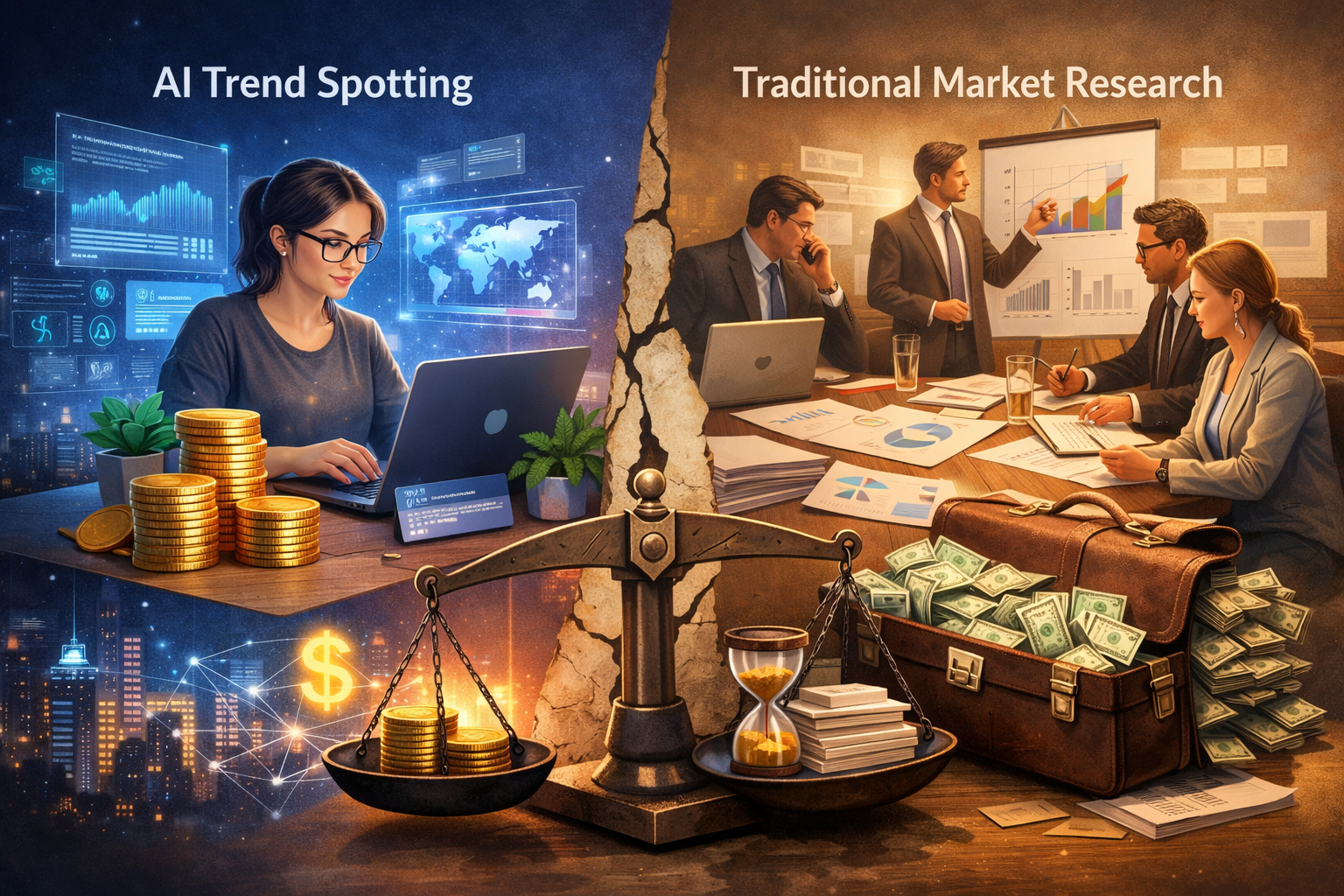
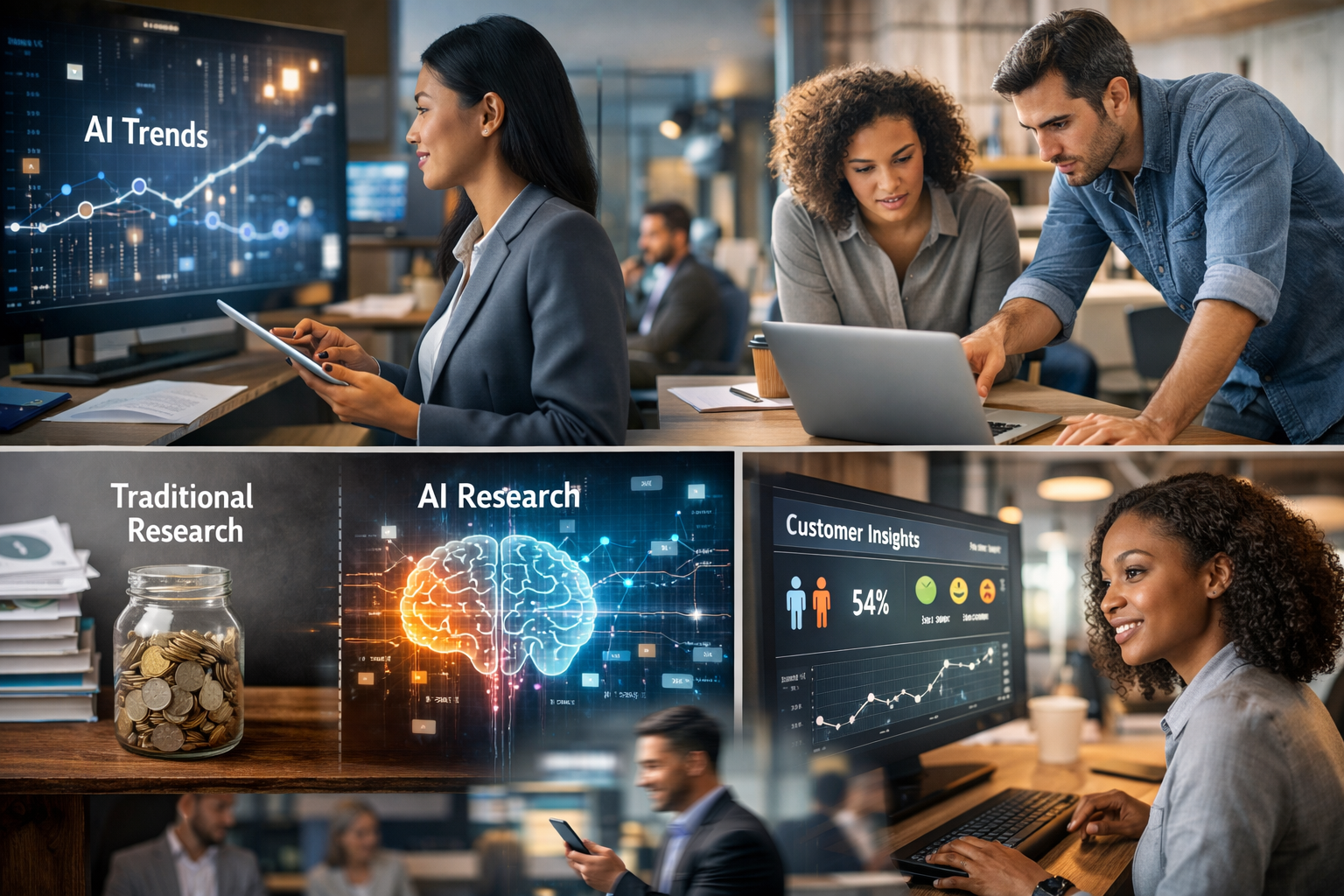
Cost is another major factor driving adoption. Traditional research requires agencies, analysts, participant incentives, and months of planning. Large research projects can become extremely expensive.
AI tools operate differently. Once set up, they continuously gather and analyze data with minimal human intervention. The financial gap between AI trend spotting vs traditional market research cost is becoming impossible for many businesses to ignore.
For start-ups and small companies, AI has made advanced research accessible for the first time. What once required massive budgets can now be done with affordable software subscriptions.
 Predicting the Future Instead of Studying the Past
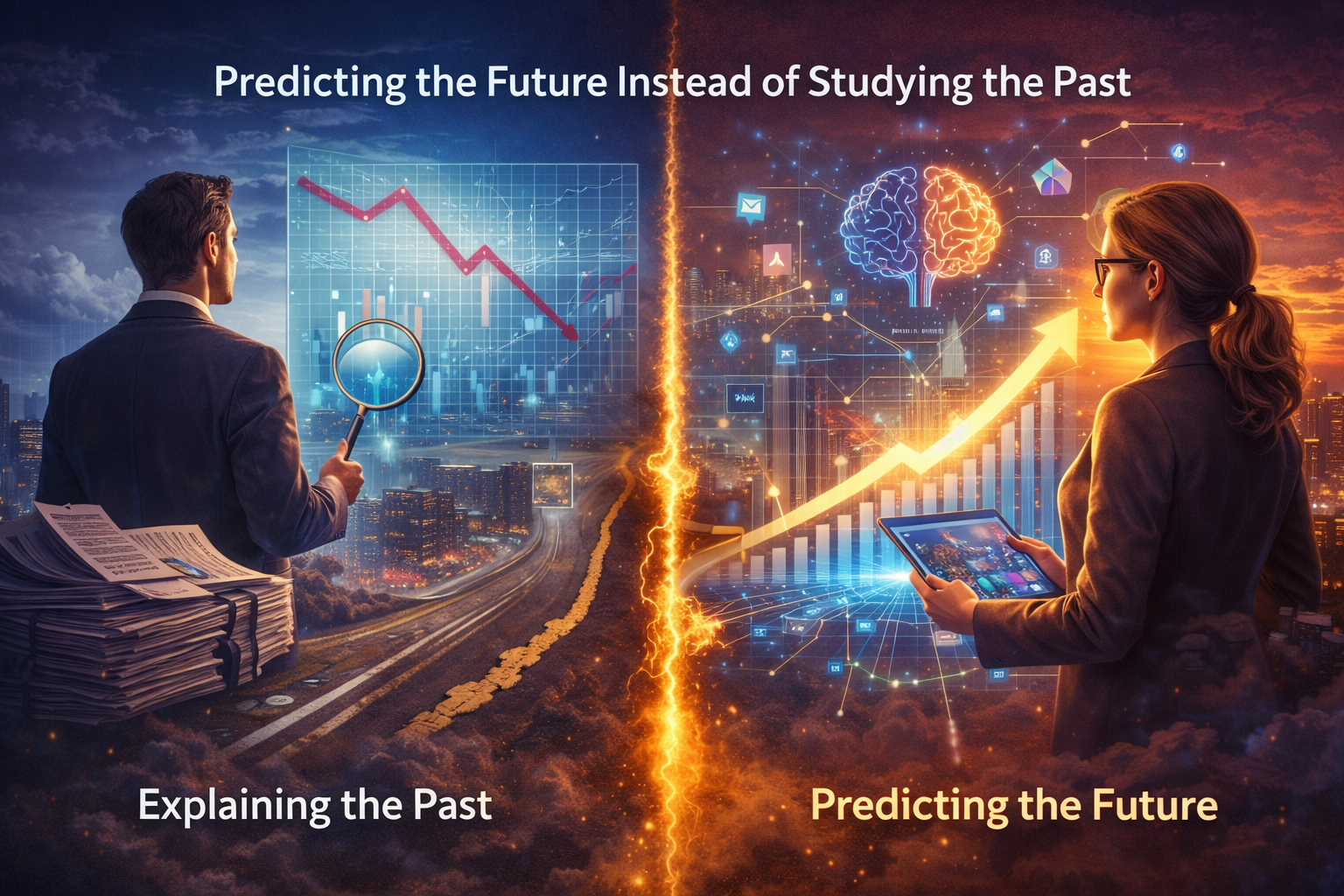
Traditional research is often retrospective. It explains what happened and why. AI adds a predictive layer by identifying patterns that suggest what will happen next.
Predictive insights are transforming decision-making. Businesses can test ideas earlier, spot emerging trends sooner, and avoid costly mistakes. This predictive capability is central to how AI is transforming traditional market research methods.
Instead of reacting to the market, companies can begin shaping it.
 Real-Time Insights and Consumer Sentiment
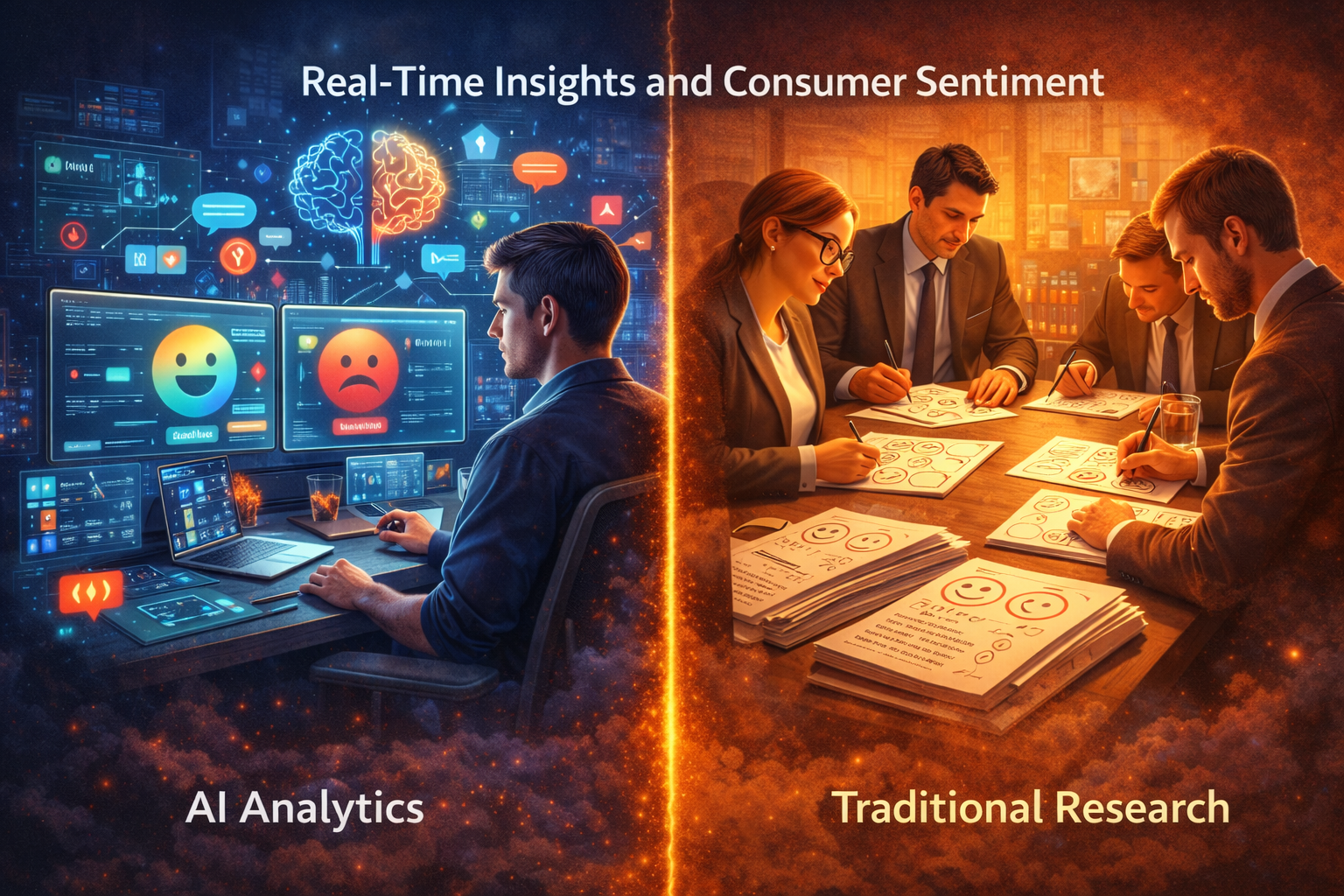
Another major shift in AI in analytics vs traditional market research methods is the ability to monitor consumer sentiment continuously. AI tools scan millions of conversations happening online every day. They can detect changes in opinion, track brand reputation, and identify emerging concerns.
This real-time awareness gives businesses the ability to respond quickly to crises or opportunities. Traditional research simply cannot match this level of immediacy.
 The Human Element Still Matters
Despite its advantages, AI cannot fully replace human researchers. Emotional nuance, cultural context, and deep storytelling remain areas where traditional research excels.
Focus groups and interviews provide rich, qualitative insights that numbers alone cannot capture. This is why the future of AI in analytics vs traditional market research methods is not about elimination but collaboration.
The most effective strategies combine the strengths of both approaches.
 The Rise of Hybrid Research Models
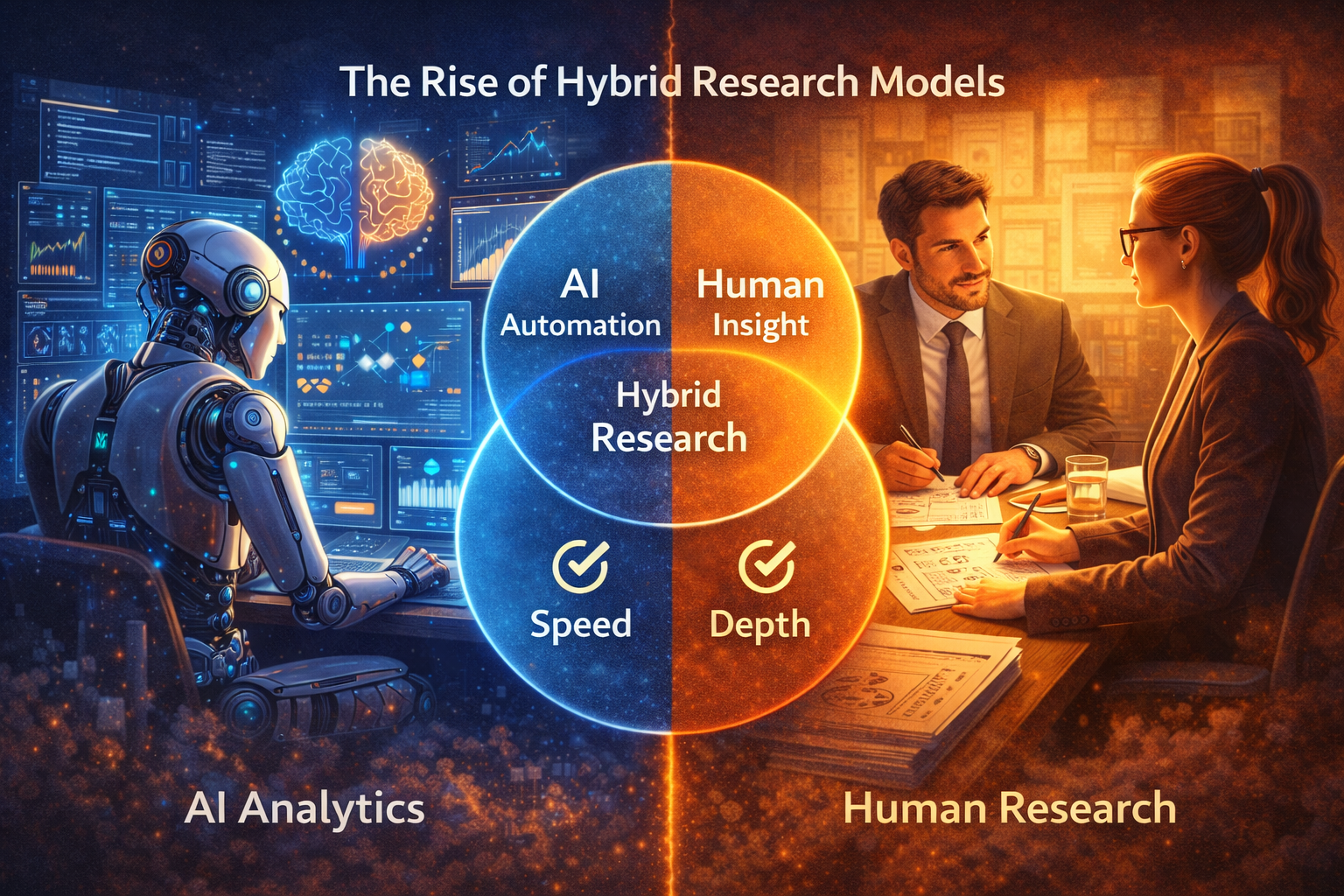
Businesses in 2026 are increasingly adopting hybrid research models. AI handles large-scale data analysis, while human researchers focus on interpretation and emotional depth.
This balanced approach shows the real meaning of how AI is transforming traditional market research methods. AI is not replacing research it is expanding its capabilities.
By blending automation with human insight, companies gain both speed and depth.
 Why Businesses Are Rapidly Embracing AI Research
The rapid shift toward AI research is driven by the need for agility. Companies must make decisions faster, adapt to trends quicker, and operate more efficiently.
The cost advantage in AI trend spotting vs traditional market research cost makes the transition even more compelling. Businesses can conduct continuous research instead of occasional studies, turning insights into an ongoing process rather than a periodic event.
This shift represents a fundamental change in how companies understand their customers.
 The Verdict for 2026
So, which wins in the debate of AI in analytics vs traditional market research methods?
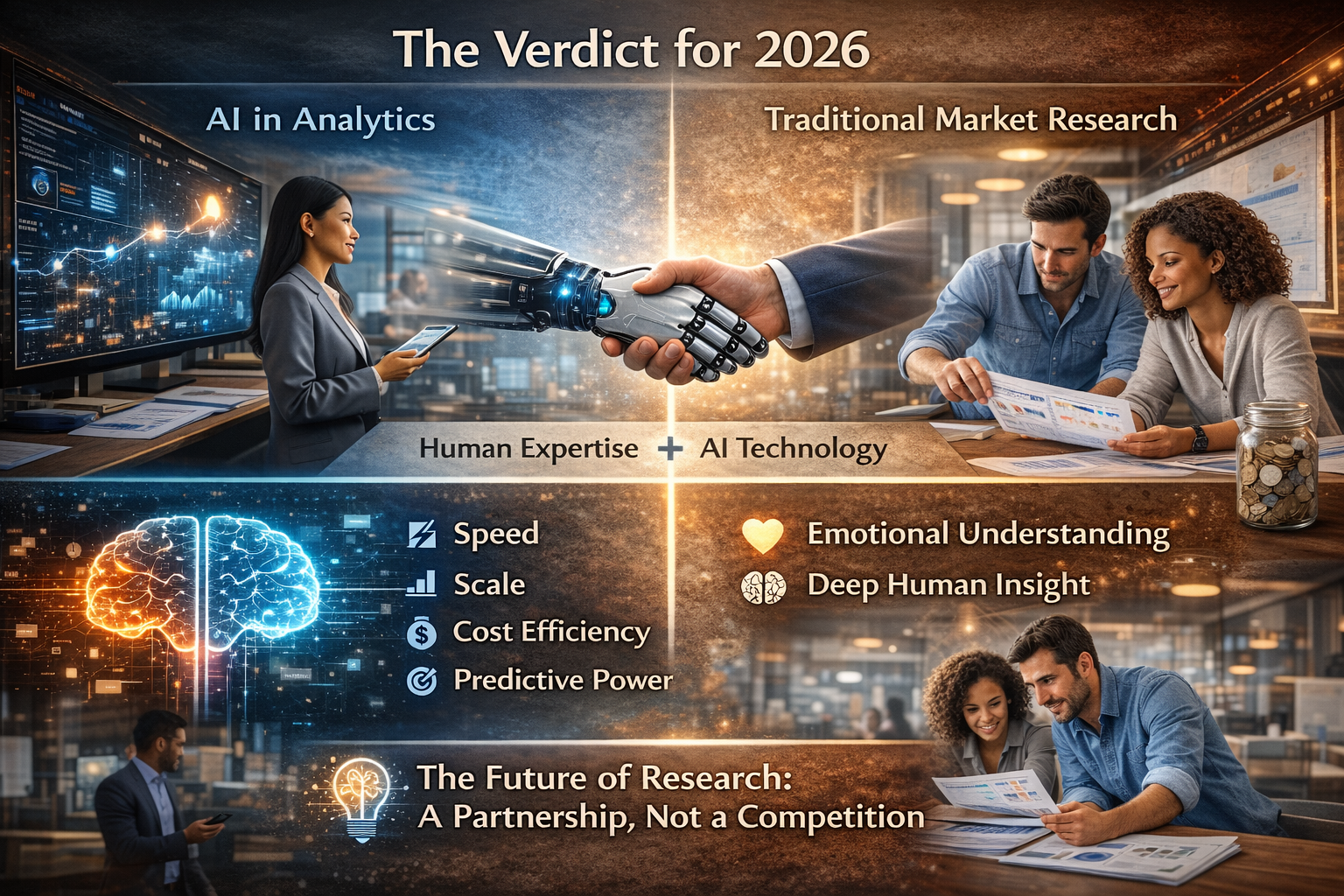
AI dominates in speed, scale, cost efficiency, and predictive power. Traditional research remains essential for emotional understanding and deep human insight. Together, they create a powerful combination that is reshaping the future of business intelligence.
Turning AI Insights into Real Business Decisions
To help businesses turn this hybrid approach into real results, SourceWithAI supports teams in adopting AI-driven research without losing the human perspective that makes insights meaningful. By combining real-time data analysis, trend spotting, and intelligent automation with strategic interpretation, SourceWithAI enables companies to move faster, reduce research costs, and make confident, evidence-based decisions. For organizations looking to bridge the gap between traditional research and modern AI analytics, this kind of partnership represents the next practical step in the evolution of market intelligence.
Final Thoughts
Market research is not disappearing it is evolving. The real story is how AI is transforming traditional market research methods and redefining what insight means in a digital world.
Companies that understand the advantages of AI trend spotting vs traditional market research cost will gain faster insights and stronger competitive positioning. Those that embrace the balance between technology and human expertise will lead the next era of innovation.
The future of research is not a competition between humans and machines. It is a partnership that combines the strengths of both.
Written by
Eva Liu
April 9, 2026 · 6 min read