Not long ago, the decision was simple. If you wanted to reduce manufacturing costs, you offshored typically to China, and later to Vietnam, Bangladesh, or India. The logic was straightforward: lower labour costs, large-scale production capacity, and an established ecosystem of factories that had been serving global brands for decades.
That logic hasn't disappeared. But it's no longer the whole story.
Supply chain disruptions, rising tariffs, geopolitical tension, and a hard-won appreciation for resilience have forced sourcing managers to ask harder questions about where their products are made and why. Nearshoring has moved from a niche alternative to a mainstream strategic conversation. And the companies that are making the best decisions aren't the ones chasing the lowest unit price they're the ones thinking clearly about total value, risk, and what their supply chain needs to do for the next five years, not just the next quarter.
This is a practical guide to making that call without the hype in either direction.
First, Let's Be Clear About What Each Actually Means
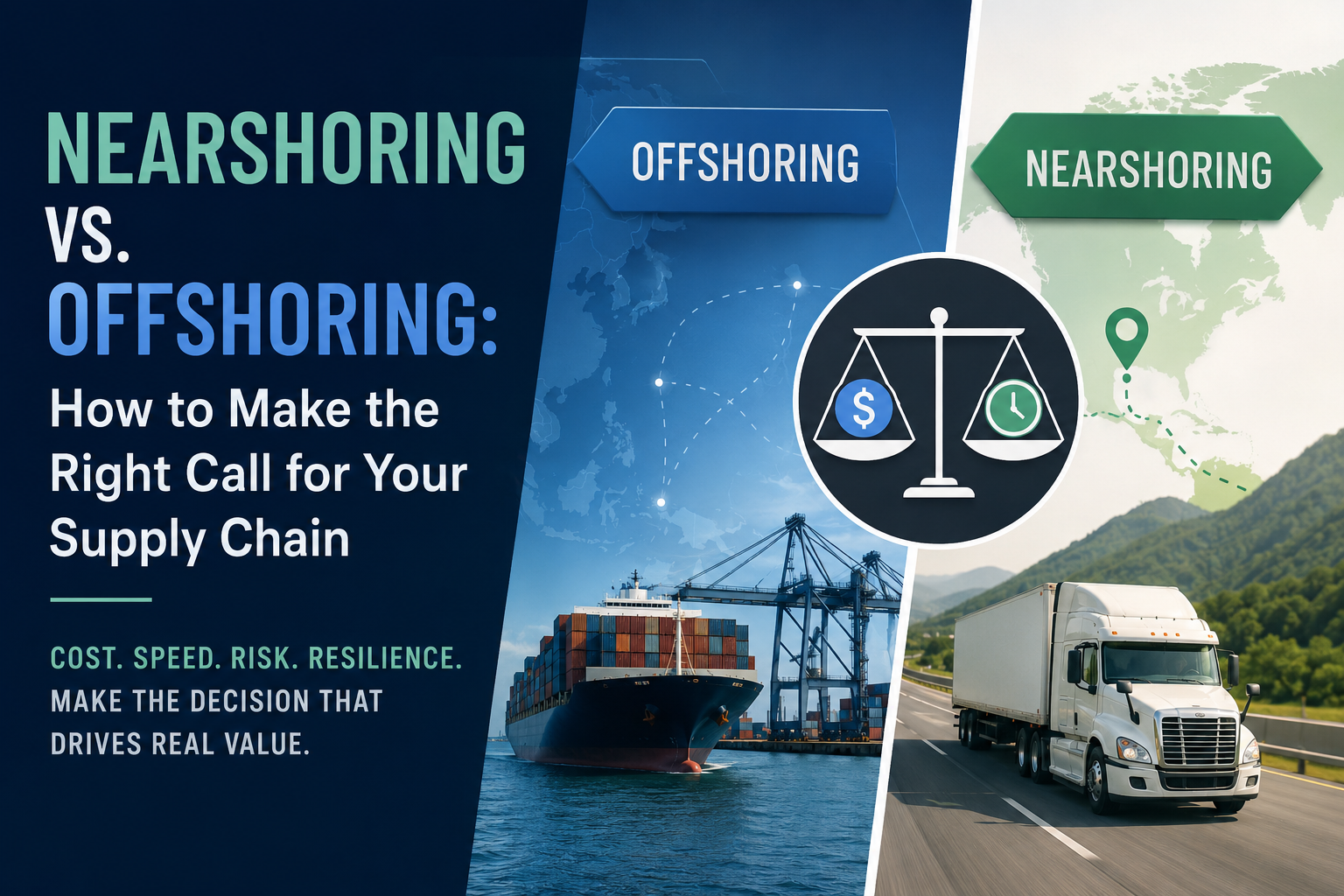
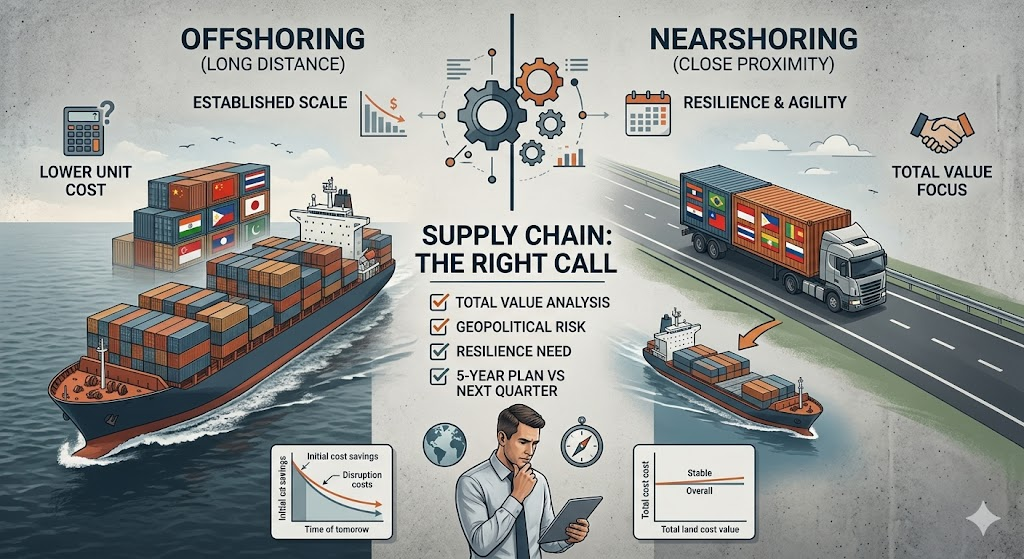
Offshoring is manufacturing or sourcing from a distant country typically in Asia to take advantage of lower labour costs, large-scale production capabilities, and established supplier ecosystems. For US-based companies, this has traditionally meant China, Vietnam, or Bangladesh. For European brands, it has meant similar Asian hubs alongside Turkey and North Africa.
Nearshoring is relocating production to a country geographically close to your primary market. For US businesses, this typically means Mexico, Guatemala, Honduras, or other parts of Central America. For European companies, it means Central and Eastern Europe (CEE), Turkey, Morocco, or Portugal. The appeal is proximity shorter shipping distances, faster lead times, and easier oversight.
There's also a third option increasingly in the conversation: friendshoring sourcing from countries that are geopolitically aligned with your home market, prioritising stability and reliability over pure cost advantage. It's less about geography and more about trust in the trading relationship.
Understanding which of these you're actually evaluating and which combination is the starting point for making a clear-headed decision.
What Offshoring Still Does Well
Let's be honest about something: offshoring reports of its death have been greatly exaggerated.
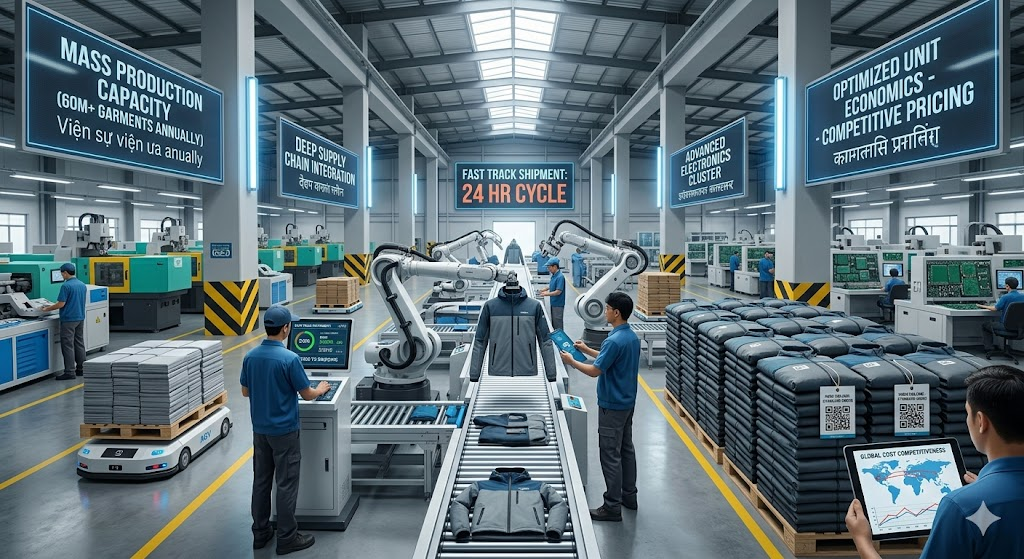
Despite years of disruption, most apparel manufacturing still happens in Asia. China alone produces more than 60 billion garments annually. India's textile and apparel sector employs over 45 million people directly. These aren't numbers that disappear overnight, and they exist for good reasons decades of accumulated expertise, deeply integrated supply chains that run from raw materials to finished goods, and production capacity at a scale that nearshoring hubs simply cannot currently replicate.
For sourcing teams, this means offshoring remains the strongest choice in specific circumstances.
If your volumes are high and your product is standardised, offshore manufacturing delivers unit economics that are very difficult to match elsewhere. If your product requires specialist skills or materials that are deeply embedded in a particular ecosystem advanced electronics, technical textiles, complex machinery the expertise cluster that exists in established offshore hubs is a genuine competitive advantage. And if your margins are tight and you are competing primarily on price, the cost differential between offshore and nearshore production can be the difference between a viable business model and one that isn't.
Speed to market is now achievable in Asia through advanced automation and strategic supplier partnerships a fact that erodes one of nearshoring's traditional selling points. The old assumption that offshore automatically means slow is increasingly outdated.
What Nearshoring Actually Solves
That said, the growth of nearshoring isn't a trend driven by sentiment. It's a rational response to real operational problems that offshoring has created problems that have become harder to ignore since 2020.
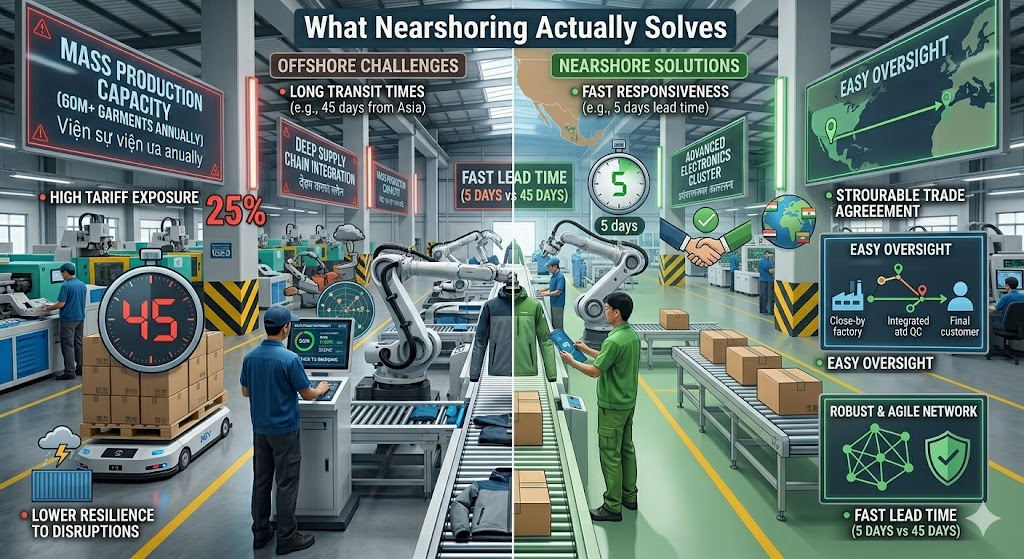
Lead time and responsiveness. Shipping from Asia to the US can take 45 days; nearshoring can reduce that to 5 days. For businesses operating in fast-moving consumer categories fashion, electronics accessories, seasonal products that difference is commercially significant. The ability to respond to demand signals, correct forecast errors, and replenish stock quickly has a real dollar value that unit price alone doesn't capture.
Tariff and trade policy exposure. Rising tariffs, long ocean transit times, and ongoing freight volatility have forced companies to reconsider traditional offshoring strategies. When a 25% tariff is applied to goods manufactured in your primary offshore hub overnight, the cost advantage that justified your entire sourcing strategy can evaporate faster than any contract cycle. Nearshoring particularly to countries with favourable trade agreements with your home market builds structural protection against this kind of exposure.
Supply chain visibility and control. Proximity makes oversight easier. Factory visits are cheaper and more frequent. Quality issues are caught and corrected faster. Communication happens in closer time zones. For brands where quality consistency is a critical part of the customer promise, this operational closeness has value that doesn't show up in a unit cost comparison.
Resilience. The COVID-19 pandemic and its accompanying supply chain issues increased the popularity of nearshoring as it enables simpler networks that are better able to handle shocks. The lesson for many was that the efficiency of these supply chains needs to be balanced with their robustness. A supply chain optimised entirely for cost but with no redundancy or flexibility is an operational liability when the next disruption arrives and disruptions, as the past five years have demonstrated, are not exceptional events.
The Hidden Trap: The Nearshoring Illusion
Here is a nuance that many sourcing managers only discover after making the switch: nearshoring does not automatically eliminate your dependency on distant supply chains.
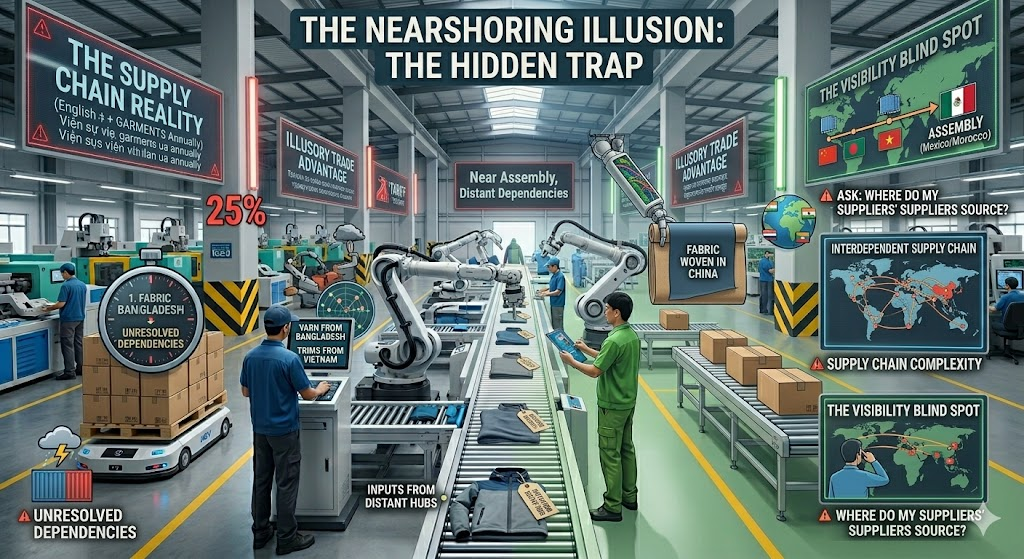
Brands can move closer to home for faster delivery, only to discover they still depend on fabrics imported from Asia a situation described as the "Nearshoring Trap." A garment assembled in Mexico or Morocco may still be made from fabric woven in China, dyed in Bangladesh, and finished with components sourced in Vietnam. The assembly happens closer to home; the supply chain complexity doesn't go away.
This matters because it means the cost and resilience benefits of nearshoring are only fully realised when the nearshore location has a genuinely integrated supply base not just assembly capability. Before committing to a nearshore strategy, sourcing managers need to ask: where do my suppliers' suppliers source their inputs? The answer often reveals whether the nearshore move delivers the resilience improvement it promises or simply relocates one part of the problem.
The Framework: How to Actually Make the Decision
Rather than asking "should we nearshore or offshore?", the more useful question is: "What does our supply chain need to do, and which model best supports that?"
Here are the factors that should drive the analysis:
Volume and scale. High-volume, standardised production favours offshoring. Lower-volume, variable, or fast-moving production favours nearshoring. If your volumes sit in the middle, the calculation depends on your margin tolerance for the speed premium nearshoring commands.
Speed sensitivity. How quickly do you need to respond to demand changes? If your business model depends on fast replenishment, seasonal agility, or trend responsiveness, the lead time advantage of nearshoring has a direct revenue value calculate it explicitly before comparing unit costs.
Risk profile. Map your current supply chain's exposure to tariff changes, geopolitical risk, and single-source concentration. If your risk is concentrated in one geography, diversification whether through nearshoring or alternative offshore locations has strategic value beyond cost.
Product complexity. Nearshoring factories are often optimised for smaller batches. Producing thousands of items across multiple styles can overwhelm these facilities, slowing growth and raising costs. For complex, technically demanding products, the expertise ecosystem in established offshore hubs is a genuine consideration.
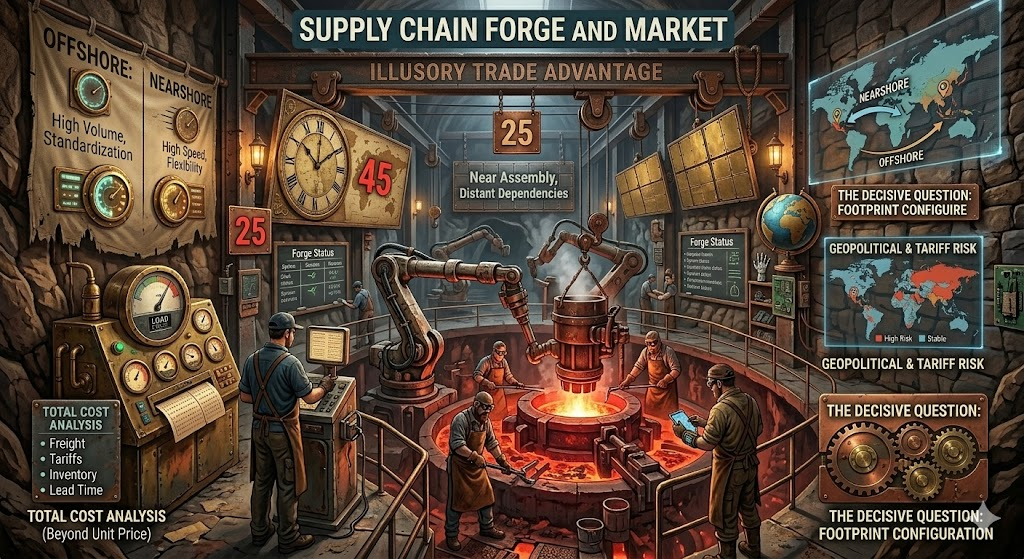
Total cost, not unit cost. The unit price comparison between offshore and nearshore production almost always favours offshoring. But unit price is not total cost. Factor in freight, tariffs, inventory carrying costs (from longer lead times), quality failure costs, and the management overhead of a more complex, distant supply chain. The gap narrows considerably and sometimes reverses.
The decisive question is no longer nearshoring versus offshoring. It is how to configure your supply chain footprint to drive both operational performance and revenue growth combining nearshoring with selective offshoring and other strategies rather than treating the choice as binary.
The Answer Most Supply Chains Need
For most sourcing managers reading this, the honest answer is: you probably need both.
The most resilient and competitive supply chains in 2026 are not fully nearshored or fully offshored they are deliberately configured to use each model where it performs best. Core, high-volume production may remain offshore where scale and cost economics are unbeatable. Faster-moving, trend-sensitive, or market-specific production shifts to nearshore locations where speed and flexibility justify the cost premium. Critical components or materials with no viable alternative source stay where the expertise is, managed with appropriate risk buffers.
According to a McKinsey report, 16% to 26% of exports worth between $2.9 trillion and $4.6 trillion could be in play whether that involves reverting to domestic production, nearshoring, or new rounds of offshoring to alternative locations. The scale of the shift underway is real. But the direction isn't a single arrow pointing from offshore to nearshore it's a diversification, a deliberate spreading of production across multiple geographies to reduce concentration risk and improve overall supply chain performance.
The sourcing managers making the best decisions right now are the ones who have moved past the binary framing and are asking a more sophisticated question: not "nearshore or offshore?" but "what is the right footprint for what we're trying to achieve and how do we build toward it deliberately?"

Where to Start
If you haven't already done this exercise, three steps will clarify your position quickly.
Map your current concentration risk. What percentage of your production is in a single country? A single supplier? If the answer is above 60%, that's the risk your supply chain is carrying and it's the starting point for any diversification conversation.
Calculate total landed cost, not unit price. Build a model that includes freight, tariffs, inventory, quality failure rates, and management overhead for your current sourcing versus a nearshore alternative. The result will be more nuanced than a unit price comparison suggests.
Identify where speed has revenue value. For each product category, estimate what faster replenishment or shorter lead times would be worth in avoided stockouts, reduced markdowns, or improved sell-through. If the number is significant, the nearshore premium may already be justified you just haven't quantified it yet.
The sourcing landscape of 2026 doesn't reward the cheapest strategy or the most fashionable one. It rewards clarity knowing what your supply chain needs to do, understanding the real cost and risk of how it currently does it, and making deliberate choices about where and how to evolve.
Nearshoring or offshoring isn't a statement about your values or your ambition. It's a decision about configuration. Make it with data, not defaults.
 SourceWithAI was built for exactly this moment when the sourcing decisions your business makes today will shape the resilience, cost structure, and supplier relationships you carry for the next decade. We combine deep sourcing expertise with a global supplier network to help teams move from uncertainty to clarity, and from strategy to execution, faster than they could alone. Whether you're a scaling brand making your first major sourcing shift or an established procurement team rethinking a footprint that no longer fits, we're the partner that helps you get it right not just get it done.
SourceWithAI.com helps supply chain professionals navigate the sourcing landscape with clarity, context, and a healthy dose of critical thinking.
Written by
Eva Liu
May 21, 2026 · 9 min read