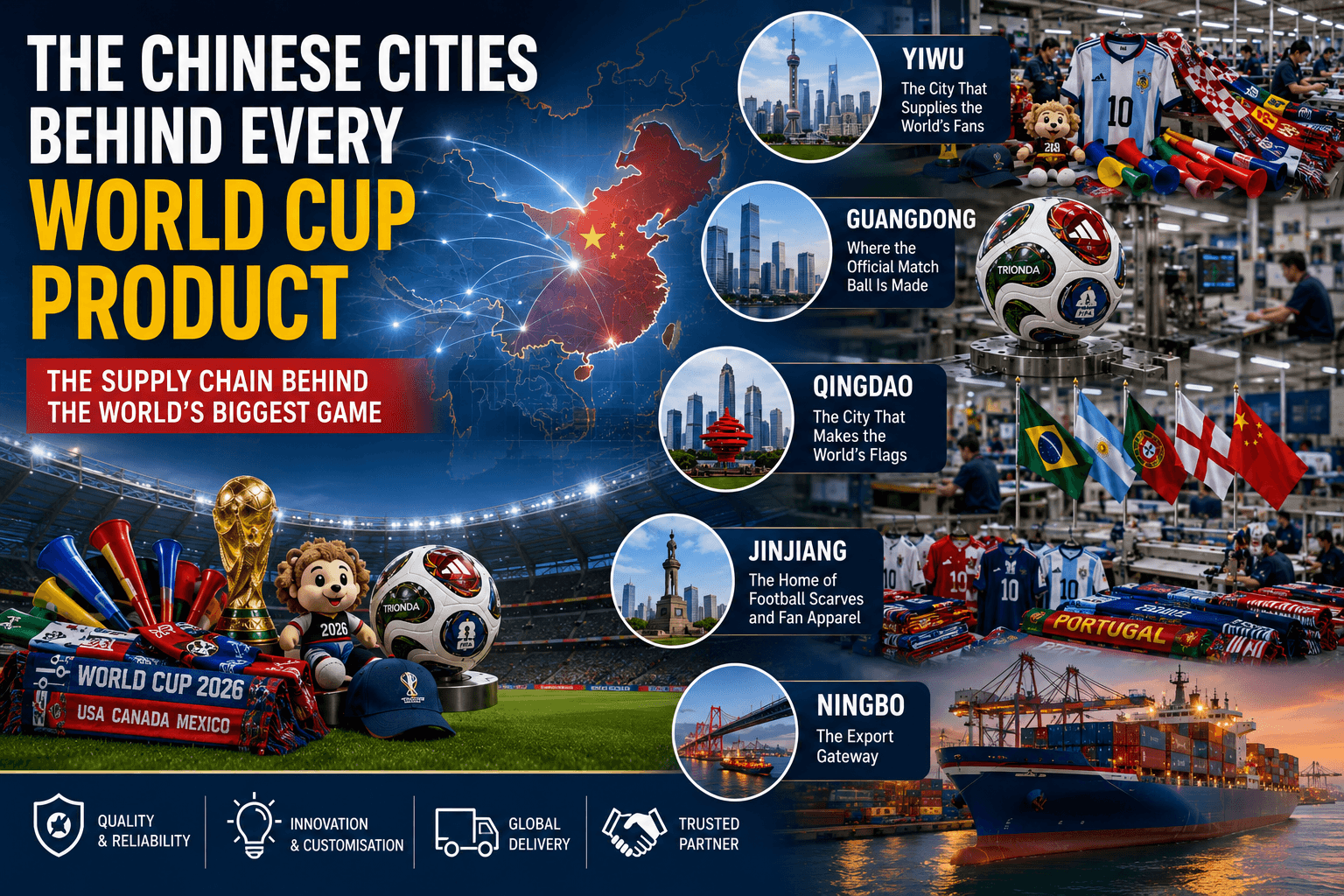
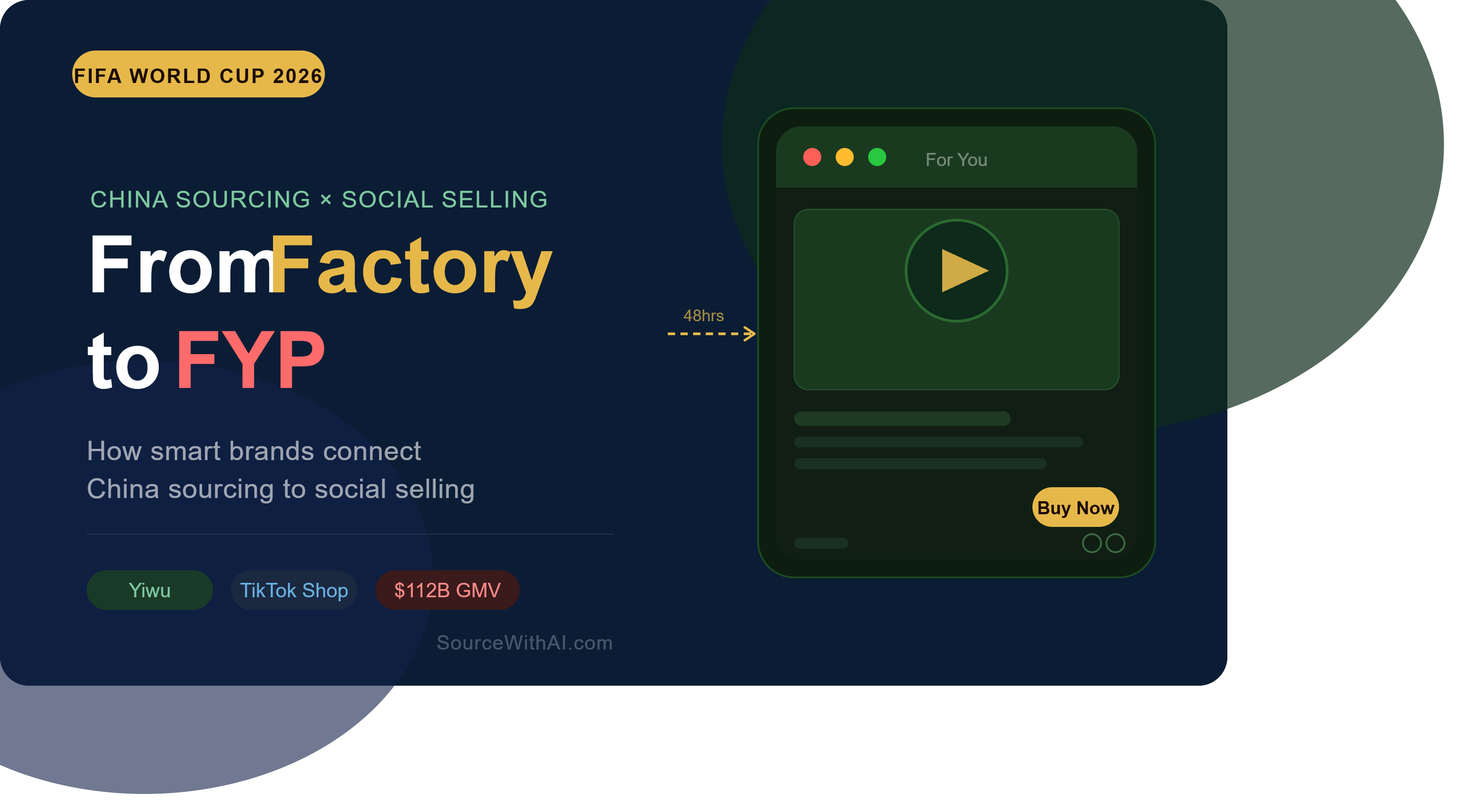
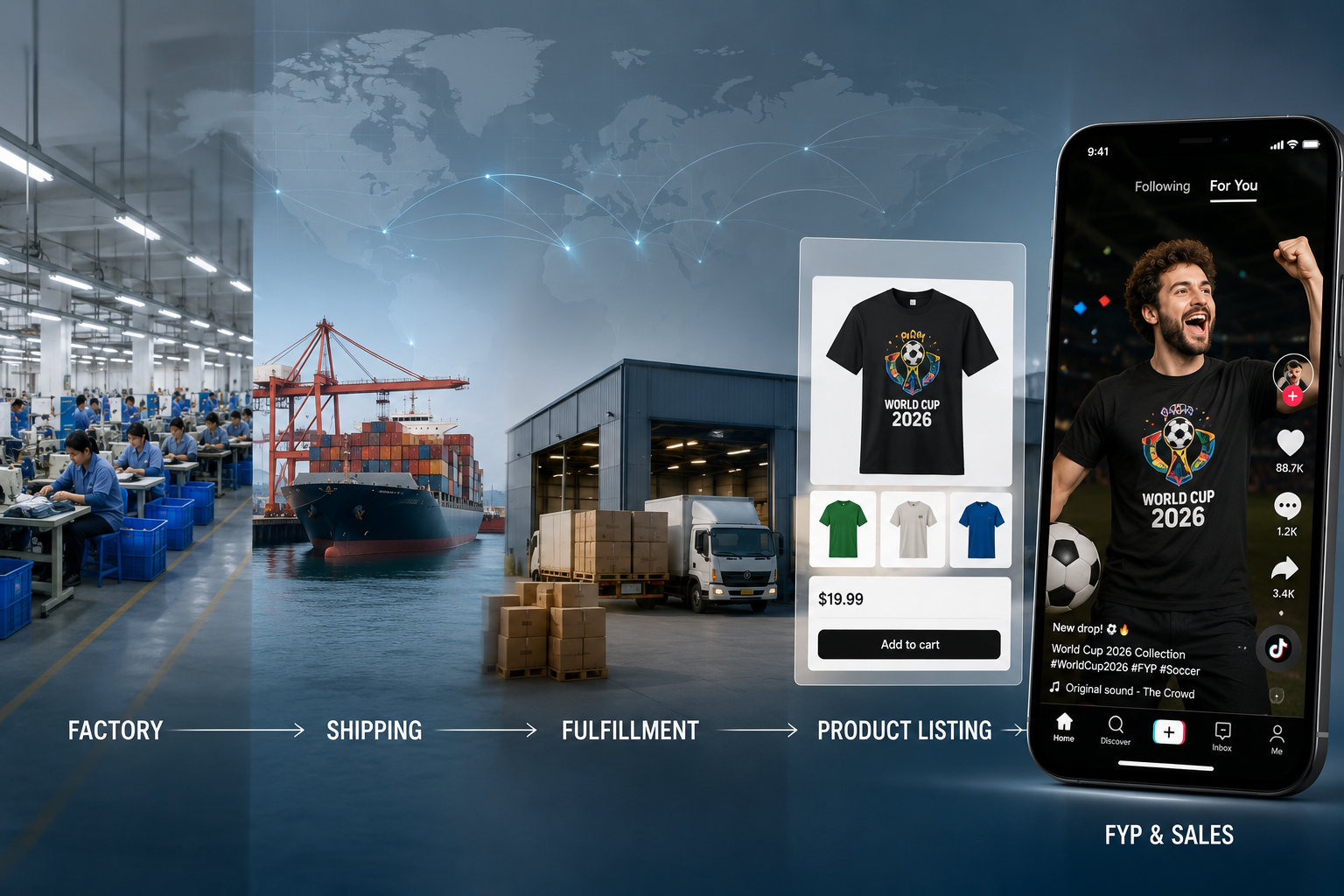
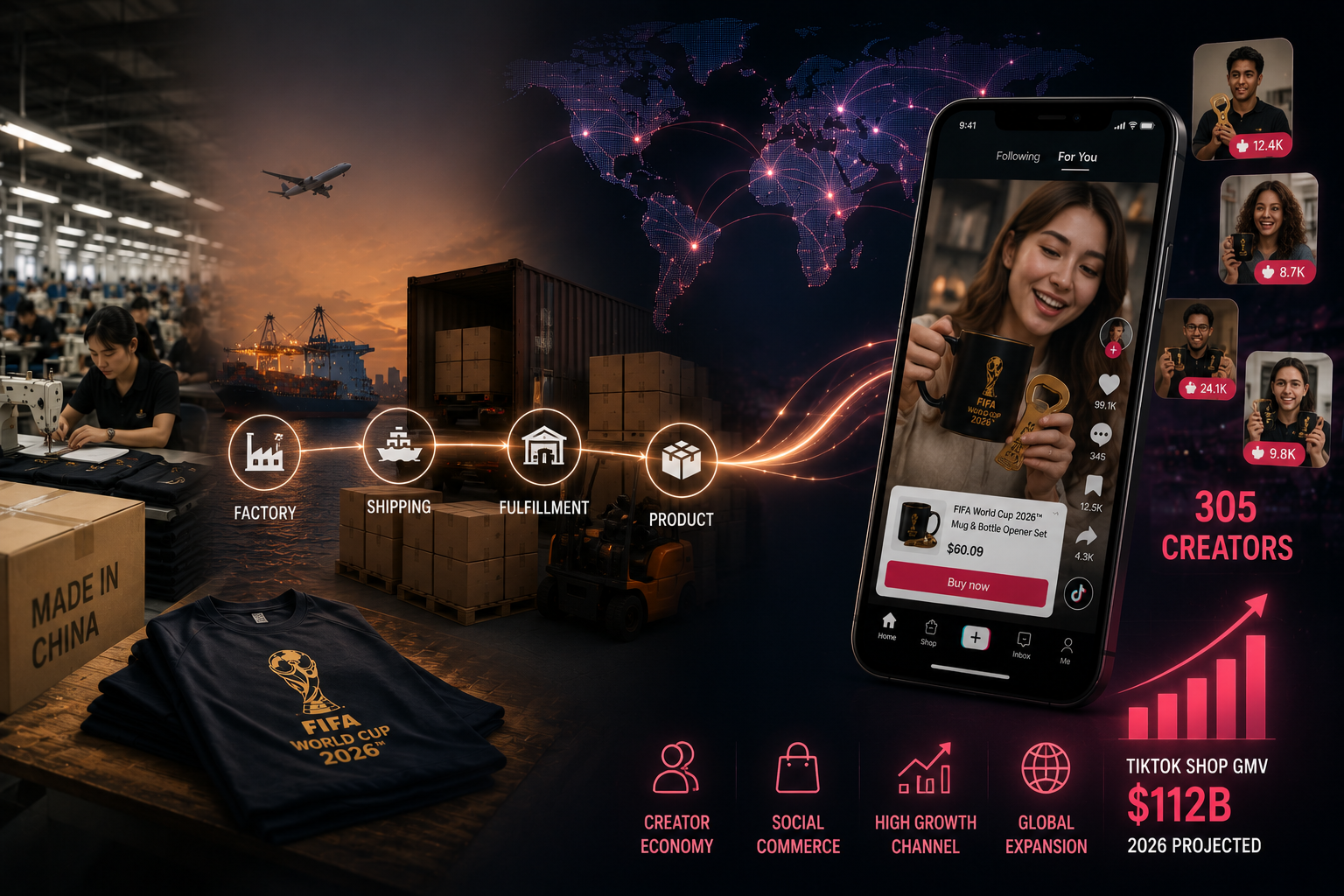
There is a new commercial loop that the smartest product brands have quietly built over the last two years. It starts in a factory in Yiwu, Jinjiang, or Guangdong. It moves through a container ship, a fulfilment centre, and a product listing. And it ends sometimes within 48 hours of a supplier shipment landing on someone's For You Page on TikTok, driving purchases at a scale that no traditional retail channel could replicate.
Factory to FYP. China sourcing directly connected to social selling. And in the context of FIFA World Cup 2026, it is the commercial model that is separating the brands winning this tournament commercially from the ones watching the opportunity pass.
Understanding how this loop works and how to build it for your own product is one of the most valuable things a sourcing-led brand can do right now.
The Platform That Changed Everything for Product Brands
TikTok Shop hit $64.3 billion in global GMV in 2025 and is on track for $112 billion in 2026. Those numbers are not a social media story. They are a commerce infrastructure story and they have direct implications for every brand that sources product from China.
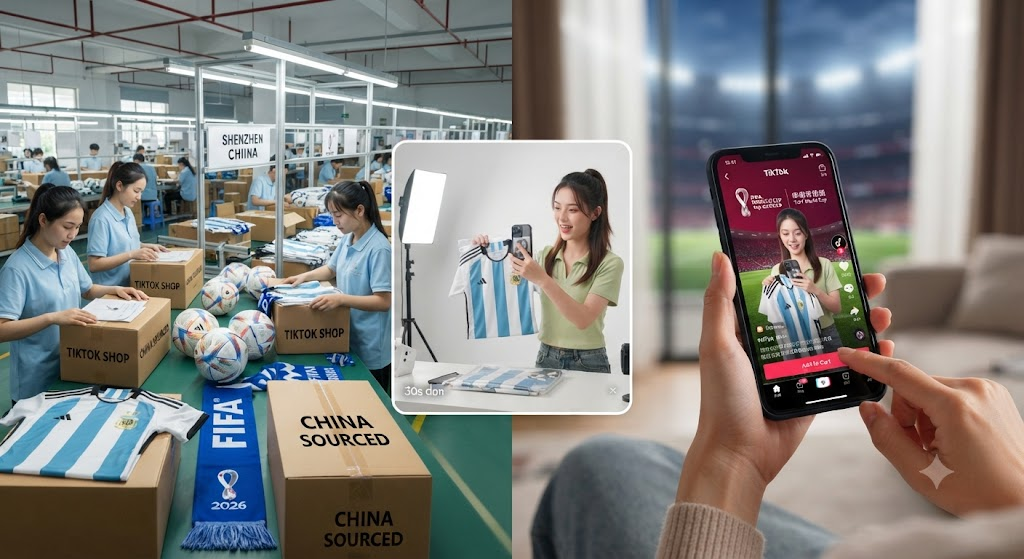
What TikTok Shop has done is compress the distance between product and purchase to a degree that no previous platform achieved. A creator films a 30-second video demonstrating a product. A viewer watches it, taps the in-video link, and completes a purchase without leaving the app. The entire journey discovery, consideration, conversion happens inside a single content moment.
For brands that have already built their China sourcing infrastructure, this is an extraordinary commercial lever. The cost of reaching a potential customer through creator affiliate marketing on TikTok Shop is a commission on sale typically 10 to 20% paid only when a purchase happens. Compare this to the cost of paid advertising, retail shelf space, or wholesale margin compression, and the economics of social selling look transformative for product brands with strong sourcing fundamentals.
FIFA recognised this early. In January 2026, TikTok and FIFA reached a first-of-its-kind preferred platform agreement, making TikTok the official content partner for FIFA World Cup 2026. This single deal turned TikTok's existing social commerce infrastructure into the primary digital commerce channel for the world's biggest sporting event and it gave brands selling World Cup merchandise on TikTok Shop an audience that was already there, already engaged, and already in a buying mindset.
What the Sales Data Actually Shows
The real story of World Cup 2026 commerce on TikTok Shop is not the one you'd expect.
World Cup commerce on TikTok Shop splits into two halves won by opposite strategies. The first half is wearable identity jerseys, apparel, fan accessories that let buyers express national affiliation in public. The second half is giftable collectibles premium products that frame themselves as gifts rather than fan accessories, targeting purchase occasions that extend beyond match-day fandom.
The most instructive single data point from the 2026 tournament: an official FIFA-licensed mug and magnetic gold bottle-opener set, priced at $60.09, generated approximately $97,560 across nearly 2,000 orders promoted by 305 creators through the simple mechanic of a pour-and-clink moment on video. A $60 drinkware gift set, not a jersey, is among the top-performing World Cup products on the platform.
What this reveals is a fundamental truth about how TikTok Shop's commerce works: if a product can't be worn, gifted, or demonstrated in a 15-second clip, it struggles. Party decor the category you'd expect to boom around a global tournament is essentially flat. A 32-country world string flag banner registered single-digit unit sales. Banners and pennants are near zero. These products have no hook on the platform. There's nothing to demonstrate, no identity to wear, and no gift-giving moment to tap into.
The brands winning on TikTok Shop during World Cup 2026 understood this before they placed their orders. They sourced specifically for the platform's commerce mechanics not just for the tournament occasion.
The Sourcing Intelligence Behind Social Commerce Success
Here is what separates a brand that sources well from a brand that sources well for social selling. They are not the same thing, and the gap between them is where most product brands leave significant money on the table.
Sourcing well means finding the right factory, at the right price, delivering the right quality on time. Every competent sourcing team aspires to this. Sourcing well for social selling adds three additional requirements that fundamentally shape product and sourcing decisions before a single order is placed.
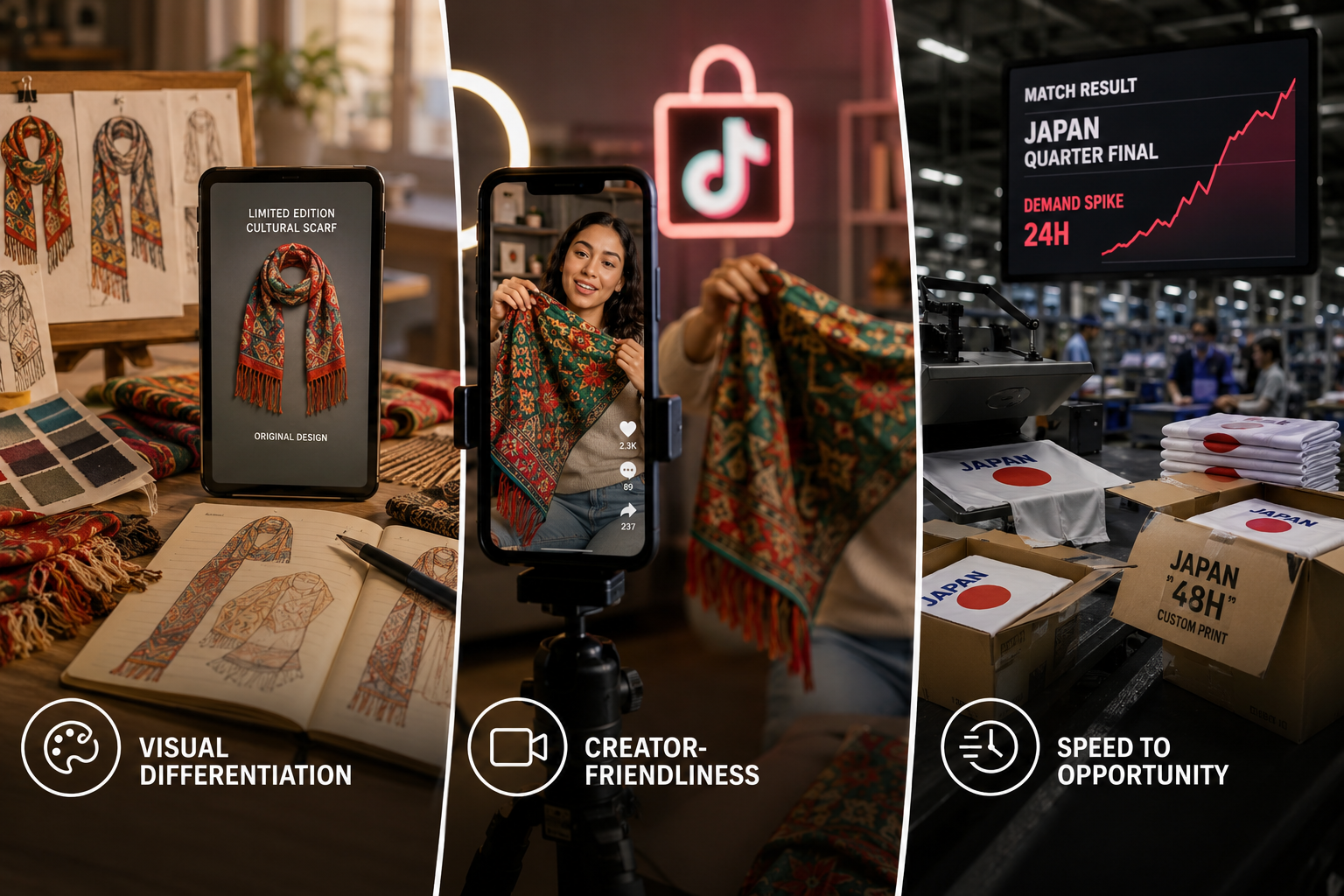
The first is visual differentiation. TikTok Shop's discovery algorithm rewards content that stops the scroll and the product is a primary driver of whether content stops the scroll or doesn't. A generic scarf in standard red-and-white stripe doesn't create a content moment. A scarf with a culturally specific design detail, an unexpected material finish, or an original graphic does. This means design investment at the sourcing stage working with factories to develop custom design elements rather than selecting from catalogue options is a prerequisite for social commerce performance, not an optional upgrade.
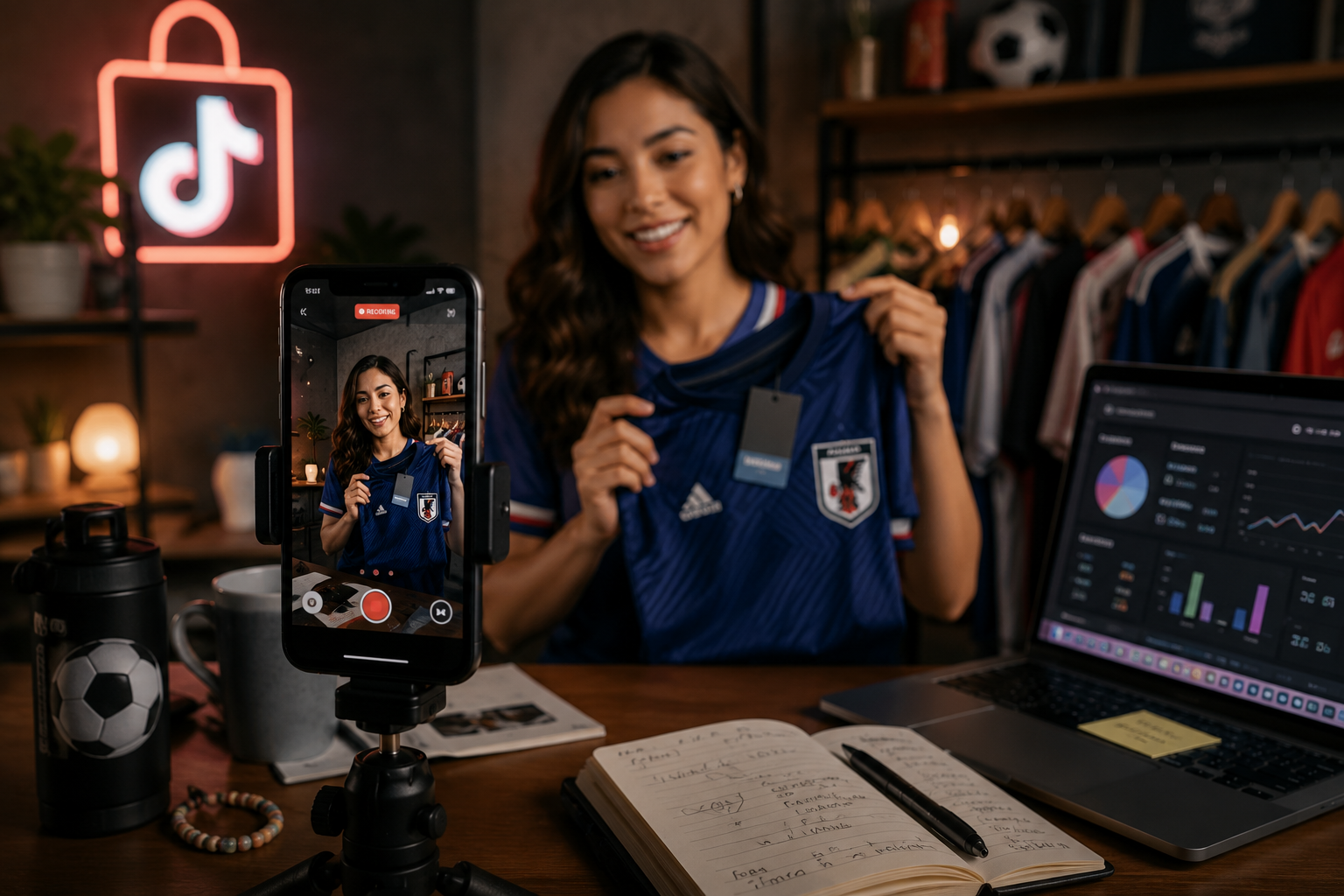
The second is creator-friendliness. The most successful products on TikTok Shop have a demonstrable moment built into their use. The drinkware set has the pour-and-clink. A scarf has the stadium wrap and reveal. A pet jersey has the dog-wearing-matching-kit moment. When selecting and designing products for social selling, brands that think about the content moment the product creates and brief their factories accordingly source products that generate creator content at scale without paying for every video.
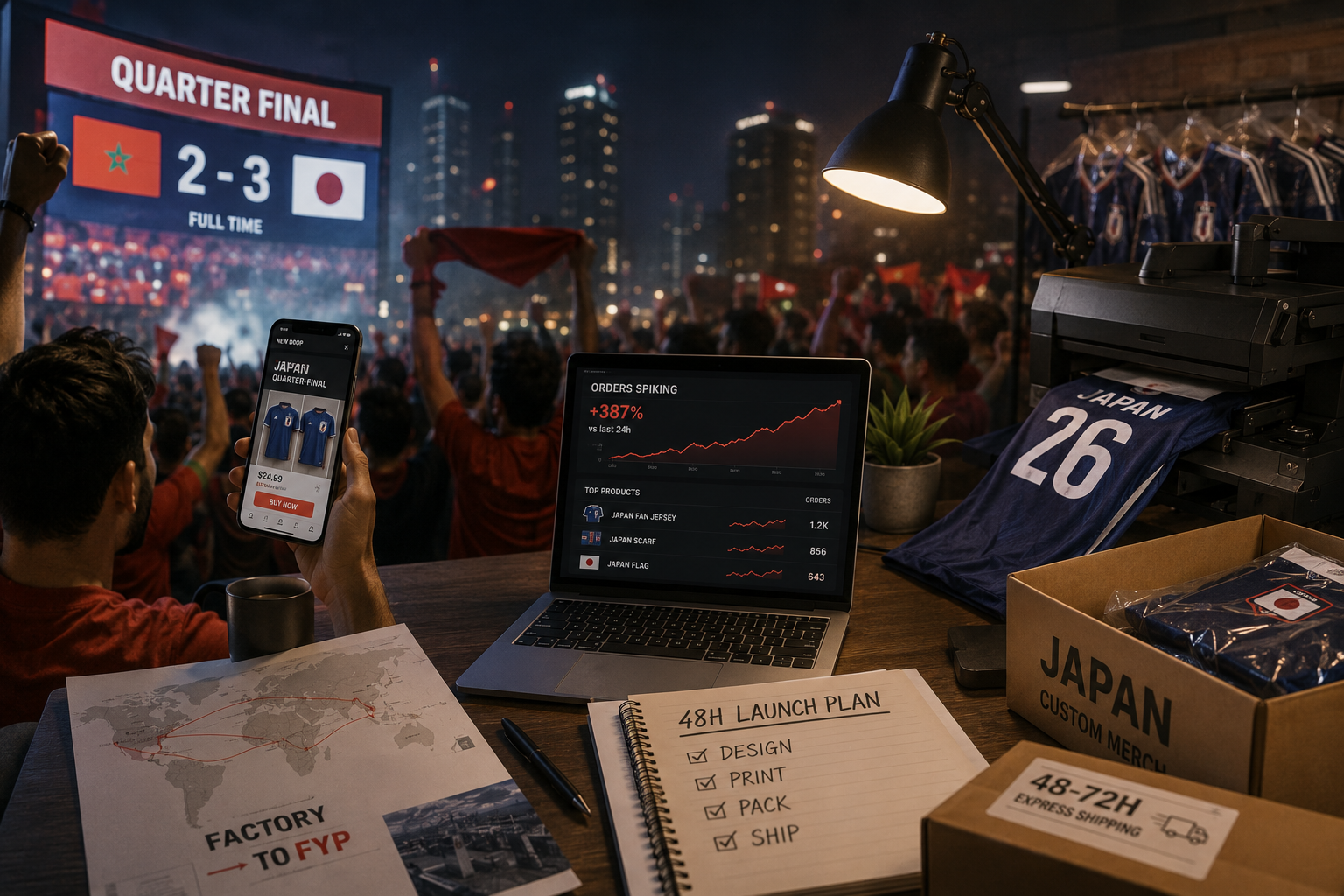
The third is speed. The World Cup example makes this viscerally clear. When Morocco or Japan or an unexpected underdog reaches the quarterfinals, merchandise demand for that nation spikes within 24 hours. The brands that capitalise on this moment are not the ones scrambling to place new orders they are the ones who built supplier relationships in advance and maintained generic inventory that can be customised in 48 hours. Suppliers in Yiwu have been running this playbook for years. Blank face stickers, solid-colour cooling towels, plain flags products that can receive a custom print or design specific to a nation that just made the knockout rounds, shipped within two days of a match result. This is factory-to-FYP operating at its most responsive, and it requires the supplier relationships to be in place long before the moment of demand arrives.
The Creator Network Is the Distribution Layer
The other half of the factory-to-FYP model that sourcing-focused brands consistently underestimate is the creator affiliate network the distribution infrastructure that TikTok Shop has built to connect products with audiences.
On TikTok Shop US, the top 1% of sellers drive approximately 60% of all GMV, and the top 0.1% account for over a quarter of it. This concentration reflects the outsized importance of the creator affiliate channel the mechanism through which products reach the audiences that buy them. Brands that have built strong affiliate creator programmes, with well-designed product pages, competitive commission rates, and product samples in the hands of relevant creators, have a distribution advantage that unit economics and platform spend cannot replicate.
For World Cup merchandise, the creator distribution strategy maps directly to sourcing decisions. A product that generates good affiliate content needs to be visually interesting on camera, competitively priced to absorb a 10-20% creator commission without destroying margin, and sufficiently different from what's already available on the platform to give a creator a reason to feature it.
This means the conversation about which product to source and what it should look like cannot happen in isolation from the conversation about how it will be sold. The brands that are winning on TikTok Shop sourced products with their creator strategy already in mind knowing which creator categories they'd target, what kind of content moment the product would generate, and what price point would work across product cost, creator commission, and platform fees while still being commercially attractive to the buyer.
The Knockout Rounds Opportunity
One of the most practically useful insights from the World Cup 2026 TikTok Shop data is the tournament's commercial structure. The group stage runs through late June. Then comes the round of 16, quarterfinals, semifinals, and the July 19 final. Each elimination creates a new wave of commercial opportunity winners celebrating, surprise nations suddenly in the spotlight, dark-horse teams generating new merchandise demand from fan bases that didn't expect to still be in the tournament.
The sellers positioned to win the knockout rounds are not the ones who front-loaded a single inventory position before the tournament began. They are the ones with flexible sourcing arrangements supplier relationships that allow rapid customisation, generic inventory that can be redirected, and the ability to respond to a match result with new product on TikTok Shop within 48 to 72 hours.
This is an advanced version of the factory-to-FYP model that requires genuine supply chain agility the kind that only comes from established, trusted manufacturer relationships where responsiveness is already built into the working dynamic. It is also the version of the model that generates disproportionate returns, because the brands operating at this speed face almost no competition from slower-moving sourcing operations that can't respond in the same timeframe.
Beyond the World Cup: Why This Model Outlasts the Tournament
The factory-to-FYP connection that the World Cup has made visible is not a tournament phenomenon. It is the emerging commercial model for product brands across categories and the World Cup has simply accelerated its development and visibility.
TikTok Shop is projected to reach $112 billion in GMV in 2026. The platform has established itself as the dominant social commerce channel in the US, UK, and across Southeast Asia, with expansion into France, Italy, Spain, Germany, and Sweden continuing through the year. The affiliate creator economy that powers its commerce infrastructure is growing, professionalising, and becoming a more reliable distribution channel with each passing month.
For brands built around strong China sourcing the ability to find the right factory, develop compelling products, and get them to market efficiently TikTok Shop represents the most accessible high-growth commerce channel that has ever existed. The brands that understand both sides of this equation sourcing and social selling and that build the infrastructure to connect them, are building businesses that are structurally advantaged in the current commerce environment.
The lesson from World Cup 2026 is not just about football merchandise. It is about what happens when great sourcing meets the right distribution channel at the right moment. The brands that figured this out for the World Cup will apply it to the next event, the next season, and the next product launch. The ones that didn't are already thinking about what they'd do differently.
How SourceWithAI Connects the Factory to Your Feed
The sourcing half of the factory-to-FYP model is where SourceWithAI operates and where the foundation of social commerce success is built or missed.
Our supplier discovery and matching service connects brands with verified Chinese manufacturers who can deliver the visual differentiation, production flexibility, and customisation capability that social selling demands. We don't just find factories that can make your product. We find factories that understand what social commerce requires speed, design capability, low MOQ flexibility for multi-SKU ranges, and the responsiveness that allows you to capitalise on real-time demand signals.
Our sourcing consultation service helps brands think through the product decisions that determine social commerce success before the order is placed design briefing, Pantone specification, creator-friendly product features, and total landed cost modelling that accounts for platform fees and creator commissions as part of the commercial equation from the start.
The FYP moment is won or lost at the factory. We help you get it right.
SourceWithAI.com helps global buyers source smarter from China with verified suppliers, expert consultation, and on-the-ground expertise that buyers can trust.
Written by
Admin
July 9, 2026 · 9 min read