Every experienced sourcing professional knows the feeling. You've got a high-stakes negotiation coming up. The supplier has been in your supply chain for years. They know your volumes, your timelines, and your dependency on their product. And you're walking into that room armed with last year's contract, a rough benchmark from a consultant's report, and your best instincts.
It's not a fair fight and it never has been.
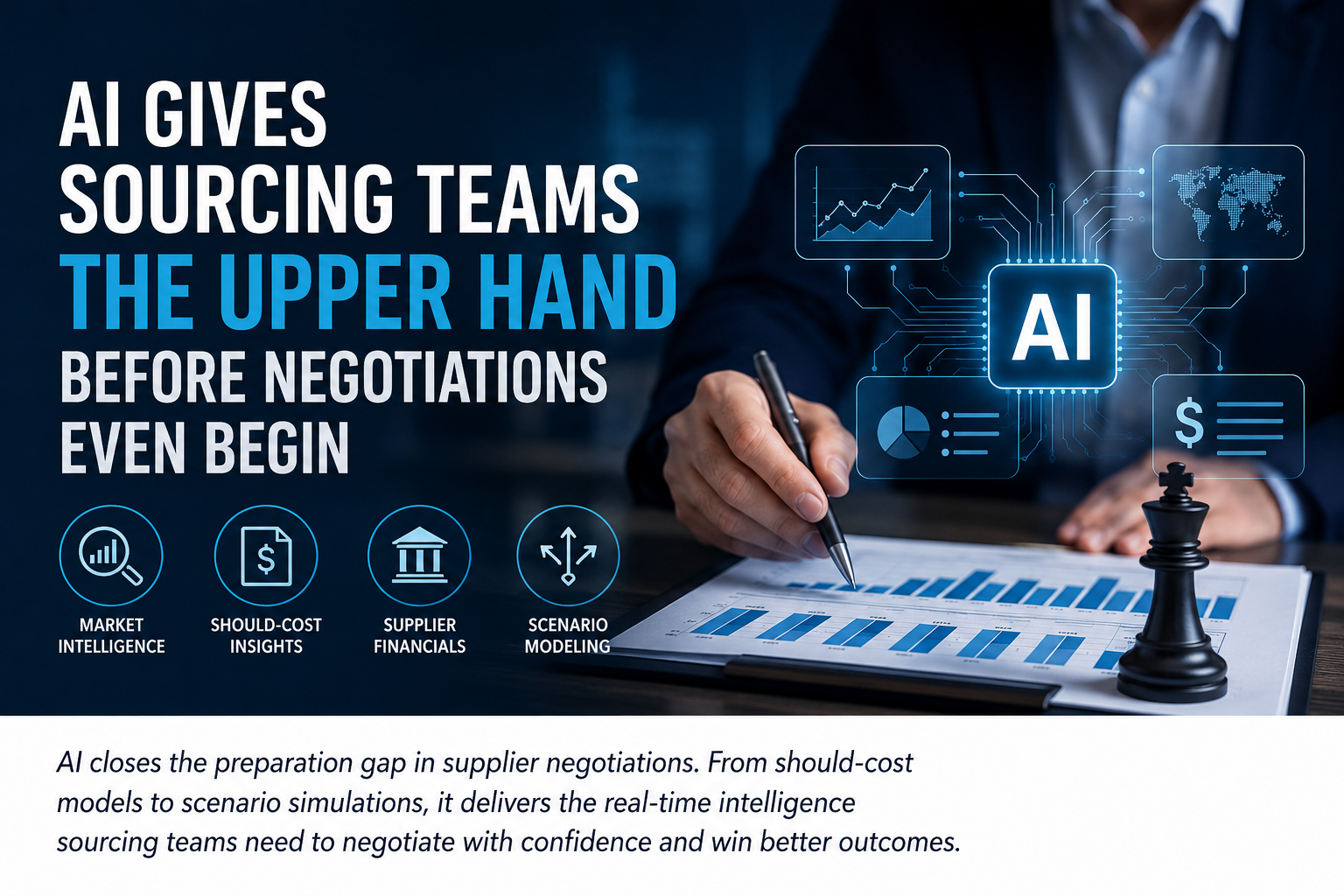
That's changing. AI is fundamentally shifting the power dynamic in supplier negotiations not by replacing the human at the table, but by ensuring that human arrives better prepared, better informed, and more strategically positioned than ever before. The competitive advantage no longer belongs to the supplier with the longest relationship. It belongs to the sourcing team with the best intelligence.
Here's what that intelligence looks like and how to use it.

The Preparation Gap That Suppliers Have Always Exploited
For decades, the information asymmetry in supplier negotiations has quietly favoured the sell side. Suppliers know their own cost structures intimately. They know their margins, their production costs, their competitor pricing, and exactly how much flexibility they have before walking away. Procurement teams, by contrast, often walk in with an approximation a benchmark from a third-party report, historical pricing from past contracts, and a sense of the market shaped more by experience than data.
That gap is where supplier margin lives.
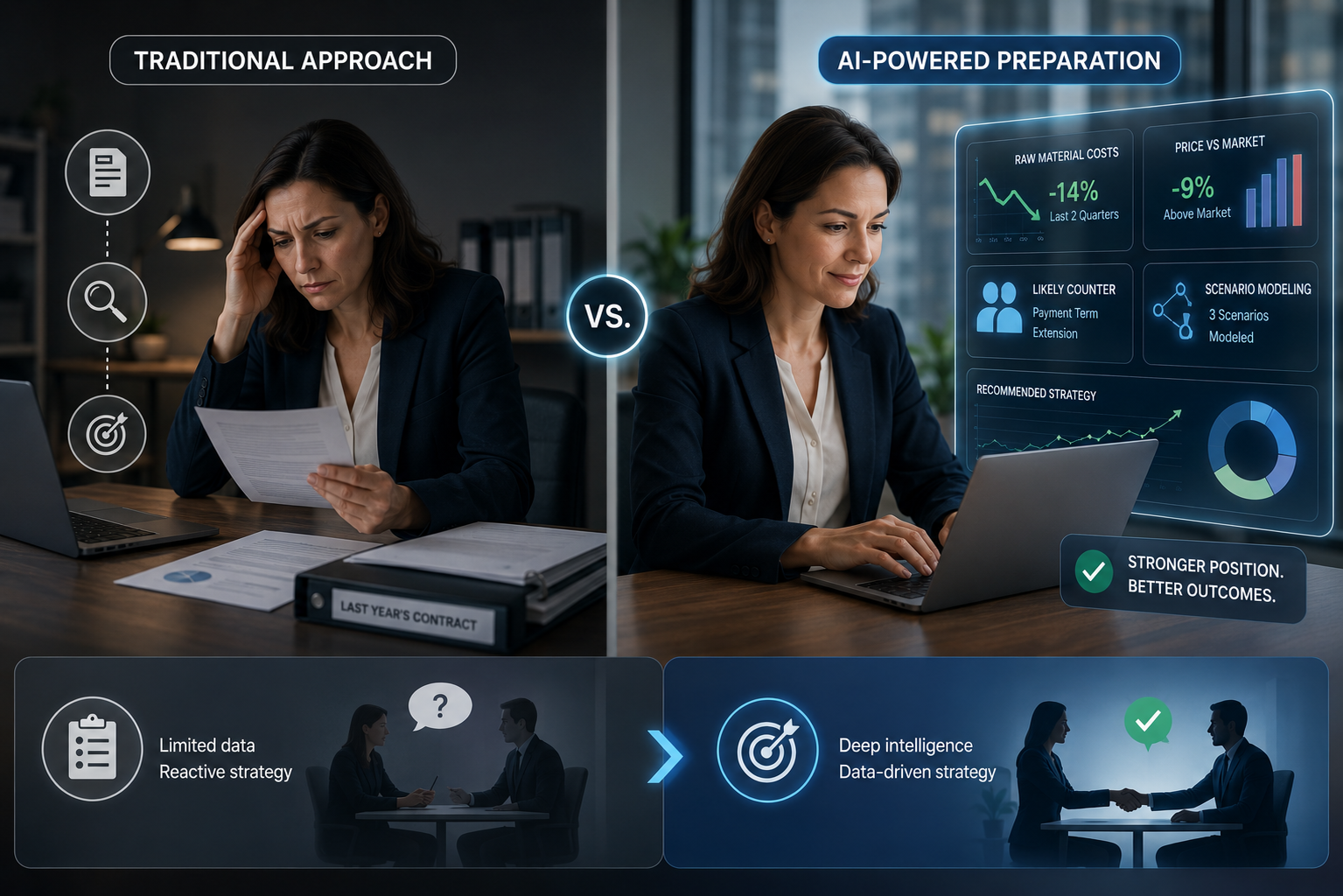
Traditional preparation meant poring through contracts or spreadsheets looking for negotiation levers long, expensive hours that still produced imprecise results. Lacking a strong data-based case for cost reductions or concessions, procurement teams often found themselves in what amounts to educated guesswork, which suppliers could easily counter by questioning the data's relevance or recency.
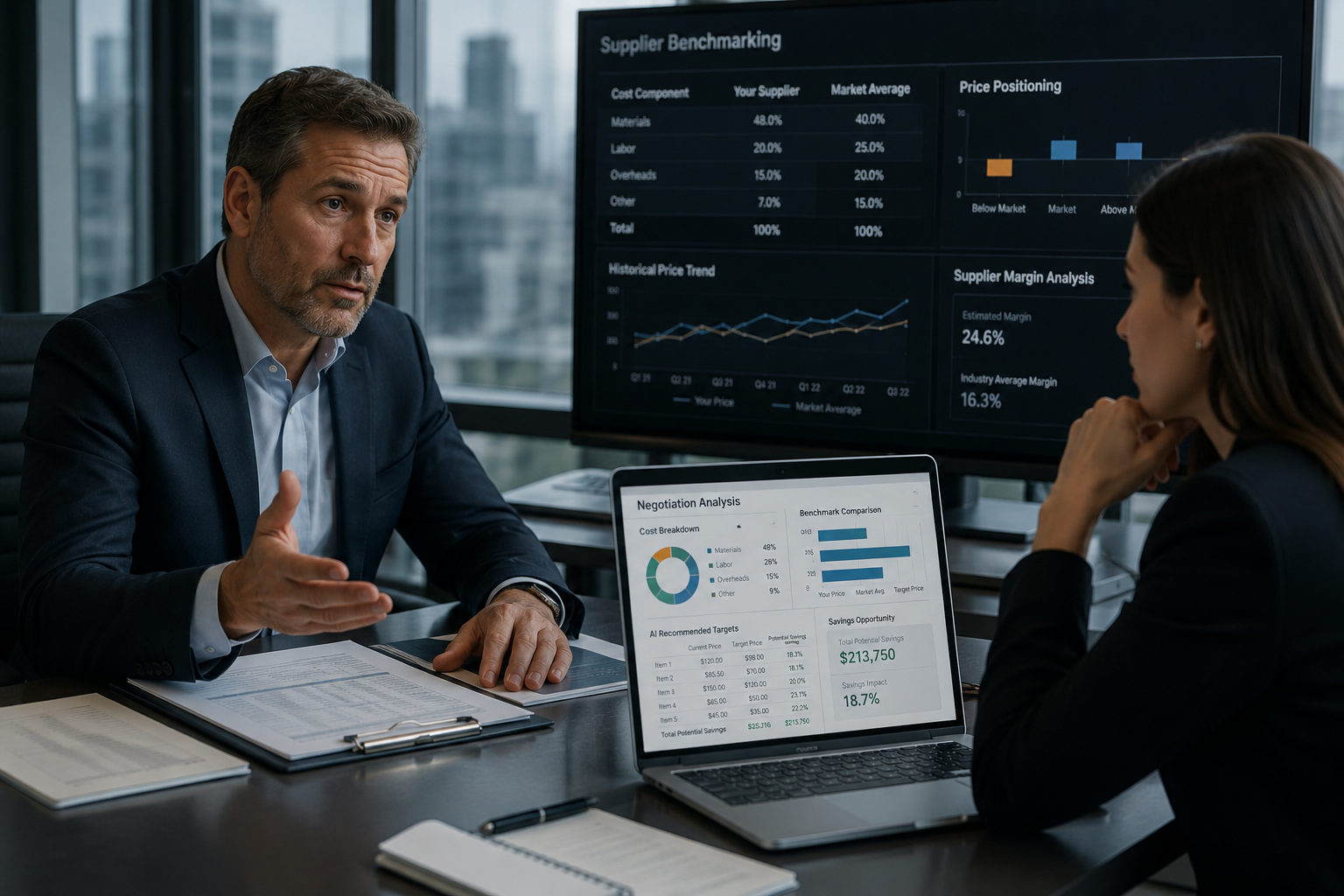
AI closes this gap not partially, but fundamentally. It gives sourcing teams a line-by-line plan for how to improve a contract, detailing the current state, the optimal asks, and supporting arguments backed by benchmarked data. For large deals, the potential savings on the table can be quantified down to specific leverage points. The days of walking into a negotiation and estimating are over for teams that have made the shift.
What AI Actually Does Before You Sit Down
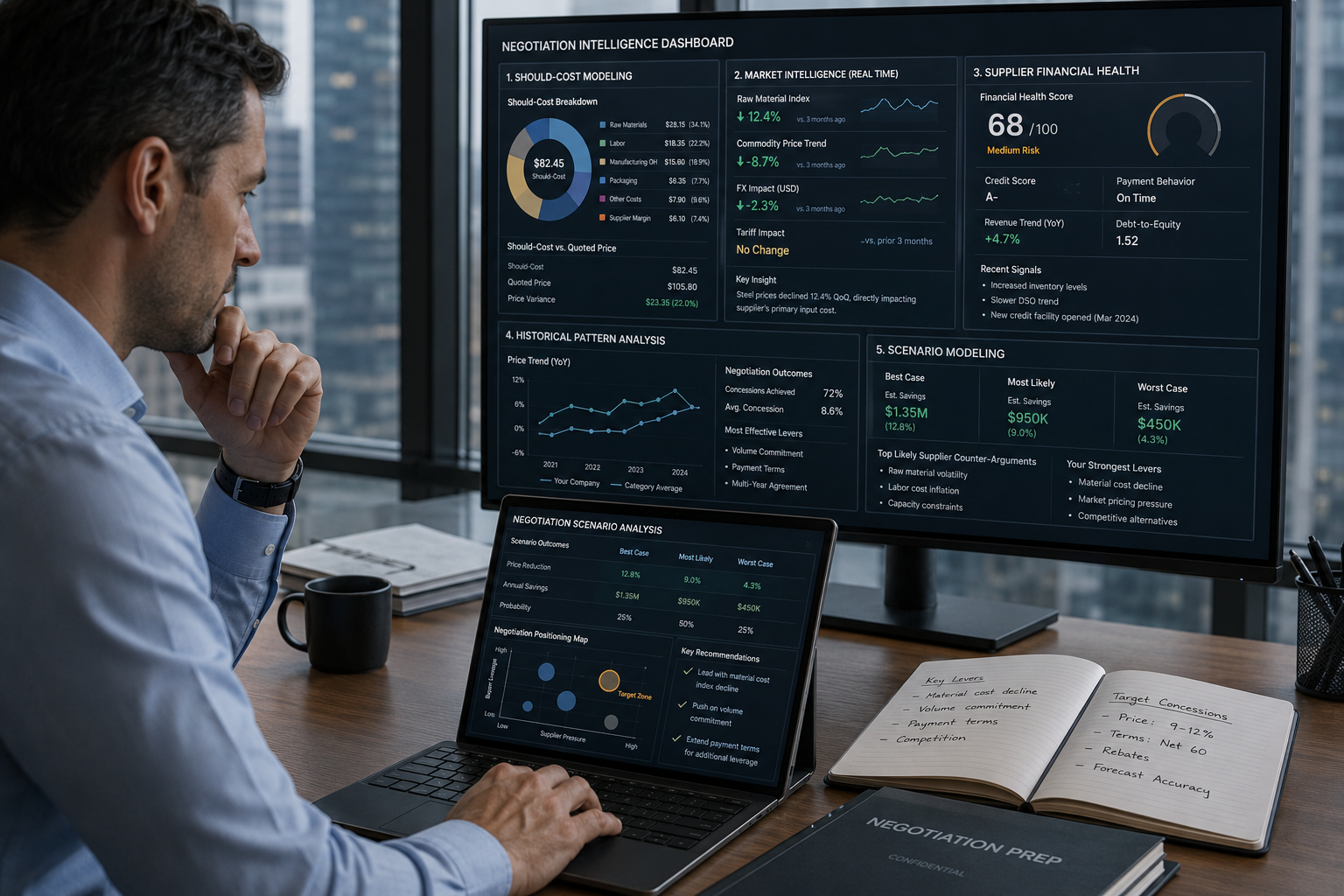
The most powerful thing AI does in negotiation preparation isn't automation it's intelligence synthesis. It takes data sources that would take a human team weeks to compile and cross-reference, and it surfaces the insights that matter most in minutes.
Should-Cost Modelling AI automatically calculates should-cost benchmarks for thousands of items the true cost of what a product or service should cost given raw material prices, labour rates, manufacturing overhead, and market conditions. Walking into a negotiation knowing the supplier's likely cost structure, not just their quoted price, is a fundamentally different position. It transforms a price-based conversation into a cost-based one and that's a conversation the prepared buyer wins.
Market Intelligence in Real Time AI systems continuously monitor external data commodity prices, currency fluctuations, tariff changes, competitor supplier activity and translate that into negotiation-relevant intelligence. If raw material costs for your supplier's core input have dropped 12% in the last quarter, your AI knows that. It means you know that. That's a lever most sourcing teams using manual research would never have found in time.
Supplier Financial Health Before any significant negotiation, understanding the financial position of the supplier across the table is critical intelligence. AI can surface financial stability signals credit scores, payment history patterns, revenue trends, public filings giving sourcing teams a real-time picture of how much pressure a supplier can realistically absorb, and where their own pain points lie.
Historical Pattern Analysis AI analyses your organisation's own negotiation history with each supplier past concessions, pricing trends, contract deviations, payment terms alongside broader patterns across similar suppliers in the same category. It identifies what worked, what didn't, and what the data suggests about this supplier's typical behaviour under negotiation pressure.
Scenario Modelling The most advanced AI negotiation tools can now simulate buyer and seller positions running through likely counter-arguments, pressure points, and trade-off scenarios before a human ever enters the room. The AI effectively stress-tests your strategy, identifying the scenarios where your position is weakest and the arguments that are most likely to land.
From Copilot to Autonomous Agent: The Spectrum of AI in Negotiations
It's worth being clear about the range of ways AI is currently operating in supplier negotiations, because the landscape has evolved significantly.
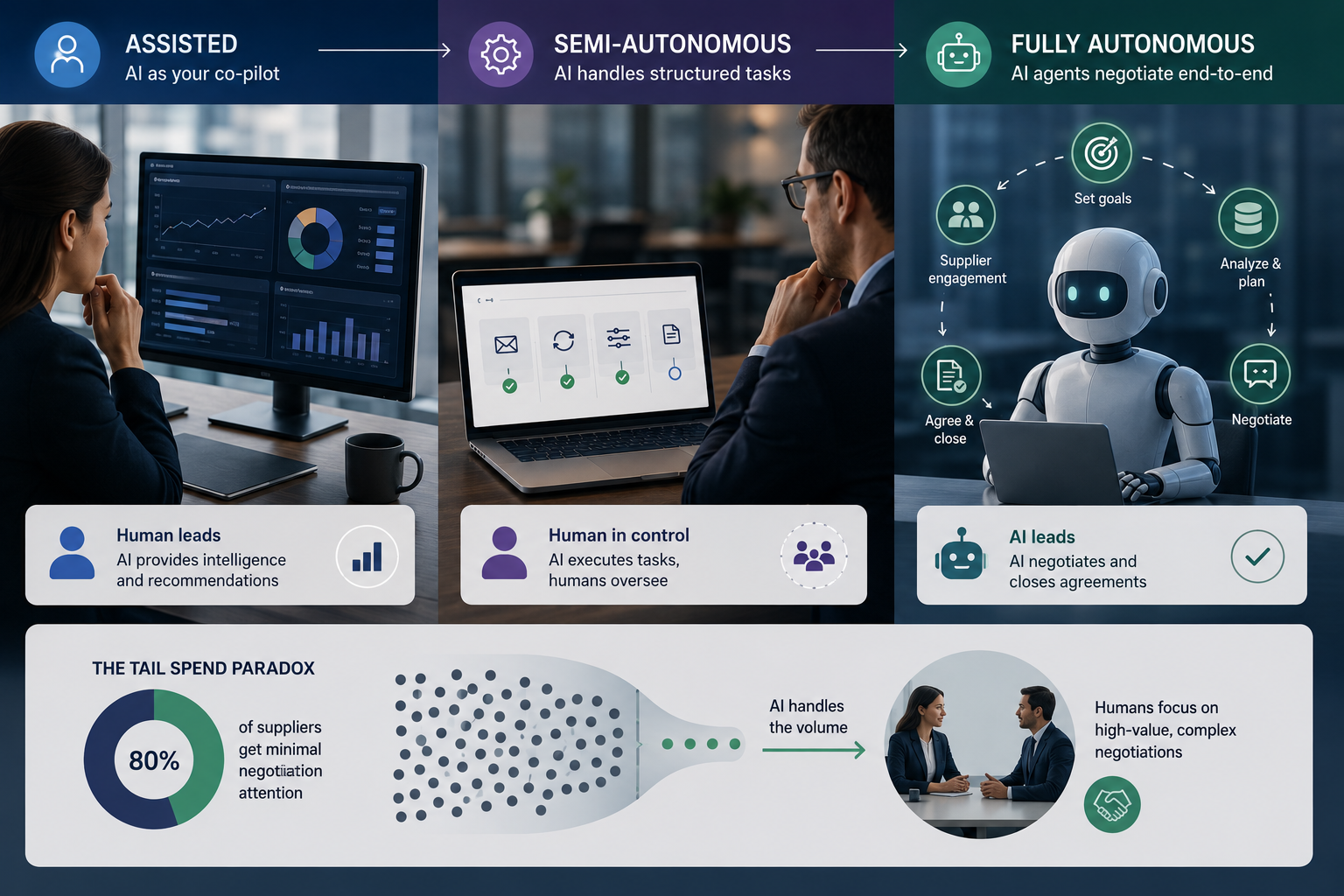
At the assisted end of the spectrum, AI acts as a co-pilot surfacing intelligence, suggesting strategies, and flagging when a supplier's offer deviates from benchmark. The human leads every interaction, but arrives vastly better prepared. This is where most mid-market sourcing teams are operating today, and it is already delivering measurable results.
At the semi-autonomous end, AI handles structured elements of the negotiation process initial bid collection, routine follow-up, counter-offer management for defined parameters while human negotiators retain oversight and final decision authority. This is becoming standard practice for high-volume, lower-complexity categories.
At the fully autonomous end, AI agents negotiate directly with suppliers processing goals, benchmarks, and historical data, then managing the full cycle from opening to agreement without human involvement in individual exchanges. Platforms like Pactum have demonstrated this approach at scale with major enterprises, focusing on tail spend categories where the sheer volume of small contracts has historically made skilled negotiation impractical.
The "Tail Spend Paradox" where the bottom 80% of suppliers account for millions in spend but individually receive minimal negotiation attention is exactly where autonomous AI delivers its clearest immediate ROI. AI handles the volume; human expertise focuses where it matters most.
The Intelligence Edge in Practice
What does this look like when it actually plays out in a sourcing context?
Consider a supply chain manager preparing for an annual review with a packaging supplier. Traditionally, this would involve pulling last year's contract, running a quick market check, and going in with a target of a 3-5% reduction based on internal budget pressure.
With AI preparation, the same manager arrives knowing that the supplier's primary raw material a specific grade of recycled polymer has seen a 14% cost reduction in the last two quarters. The AI has benchmarked the supplier's pricing against seven comparable vendors in adjacent markets and identified that the current unit price sits 9% above market rate for equivalent specification. It has flagged that the supplier's last three contract renewals with similar customers involved payment term extensions as a trade-off for pricing flexibility, suggesting that's a likely counter-offer. And it has modelled three negotiation scenarios aggressive, balanced, and collaborative with projected outcomes and risk profiles for each.
That is not a marginal improvement in preparation. It is a categorically different starting position.
What This Means for the Role of the Sourcing Professional
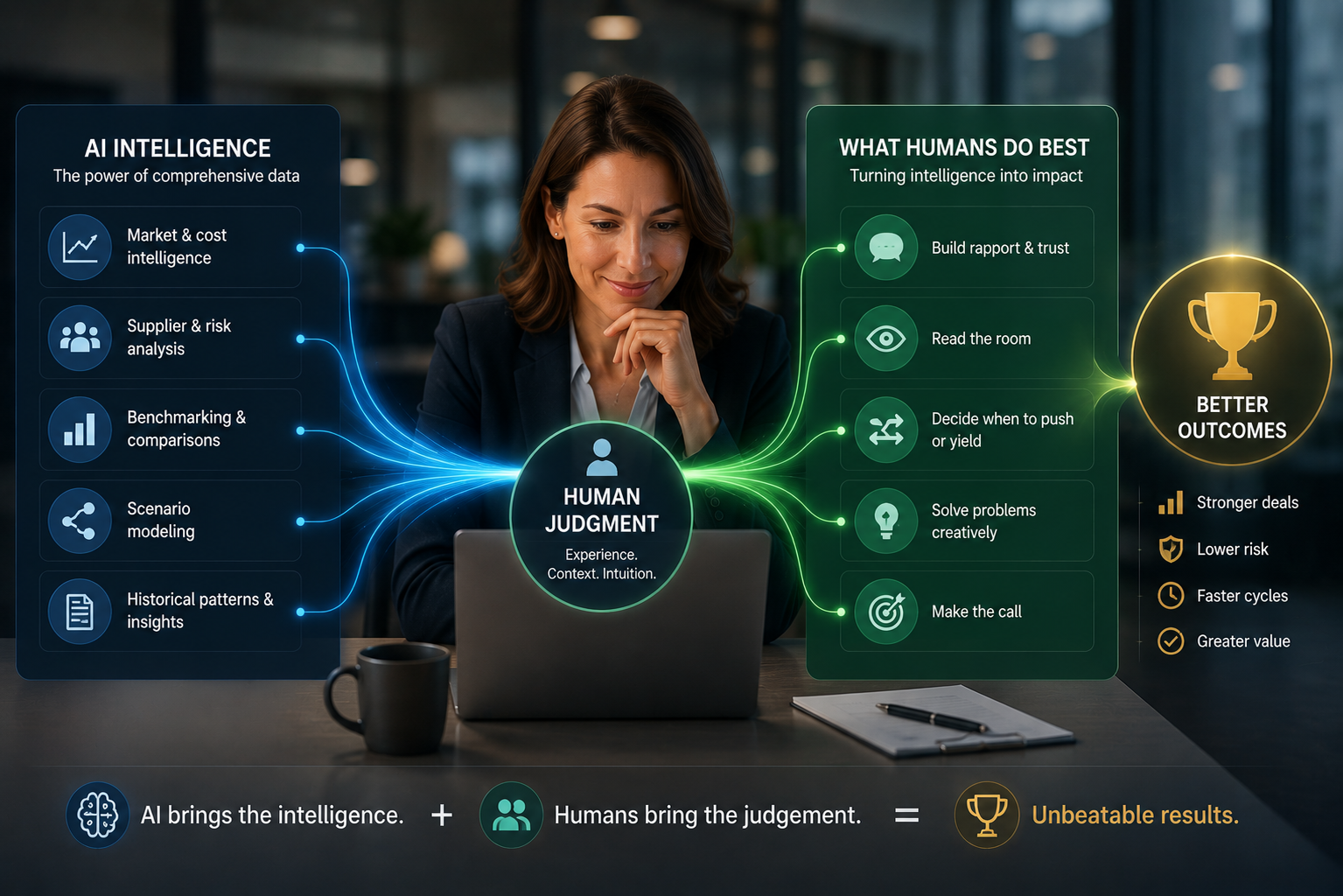
There is an important distinction worth making clearly: AI doesn't make a great negotiator redundant. It makes them exceptional.
The human skills that drive negotiation outcomes reading the room, building rapport, knowing when to push and when to hold back, making judgment calls under pressure are not things AI replicates. What AI removes is the preparation gap that has historically levelled the field between well-resourced suppliers and overstretched procurement teams.
Companies that integrate AI into their procurement strategy gain a competitive edge through faster negotiations, smarter renewals, and stronger compliance. But that edge is amplified, not diminished, when it's in the hands of a skilled sourcing professional who knows how to use it.
The sourcing teams winning the best deals in 2026 aren't the ones who replaced human judgement with AI. They're the ones who gave their human judgement the intelligence it always deserved.
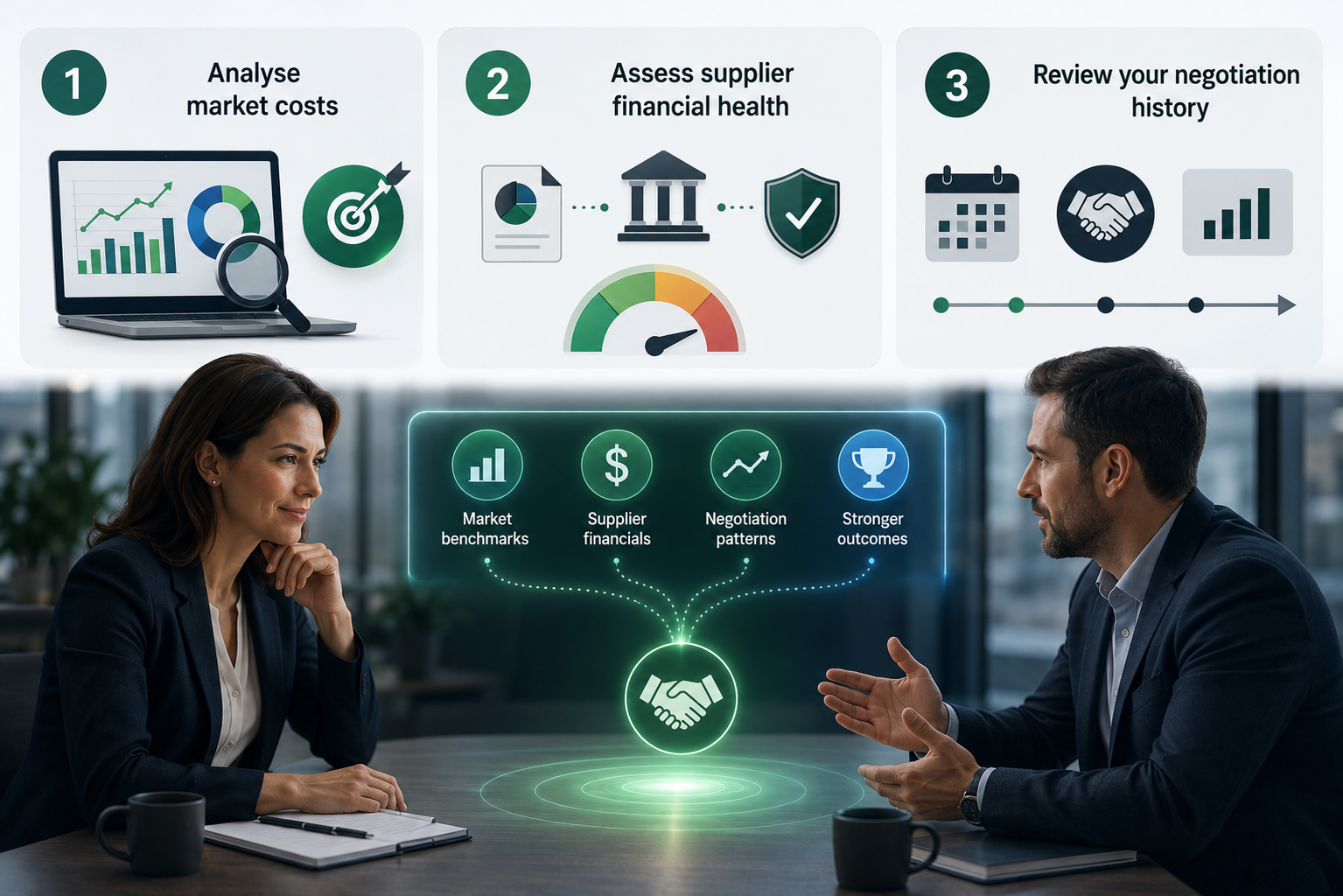
Getting Started: Three Things to Do Before Your Next Major Negotiation
1. Run a should-cost analysis on your top 10 categories. If you don't know what your highest-spend categories should cost based on current market conditions, you are negotiating blind. AI-powered should-cost tools exist across a wide range of price points and can be deployed ahead of specific events rather than as a full-platform commitment.
2. Pull your supplier's financial profile. Before sitting down with any strategic supplier, know their financial position. AI tools can aggregate this intelligence from public filings, credit data, and market signals in minutes. Understanding how much pressure your supplier can realistically absorb changes how you construct your strategy.
3. Analyse your own negotiation history with this supplier. Your historical data is an intelligence asset most sourcing teams underuse. AI can surface patterns in past negotiations the concessions you gave, the terms you accepted, the price trends over time that reveal where you have leverage and where you've consistently left value on the table.
The Shift Has Already Happened
The sourcing teams on the other side of the table from your suppliers are already using AI to prepare. They know the benchmarks. They've modelled the scenarios. They've analysed the supplier's financials. They walked in ready.
The question is whether your team is walking in with the same intelligence or whether the preparation gap that has always favoured the sell side is still quietly working against you.
AI doesn't guarantee the outcome of any negotiation. Relationships, context, and human judgement still determine who leaves the room satisfied. But it guarantees that your team arrives with the clearest possible picture of what a good outcome looks like and that is the most important advantage of all.
The upper hand starts before the negotiation begins. AI is how you build it.
SourceWithAI.com helps supply chain professionals navigate the AI-powered sourcing landscape with clarity, context, and a healthy dose of critical thinking.
Written by
Eva Liu
May 14, 2026 · 7 min read